
Republics Need Bridges


The military and Harvard shaped my family. Severing that bond weakens us all
I exist because the Army and Harvard once made room for each other.
My father came to this university through the Army more than 35 years ago as part of his training to become a Foreign Area Officer, earning a master’s in East Asian Studies. Along the way, he met my mother, who was a classmate in a Korean history class.
My father’s path to Harvard wasn’t a straight one. The son of Korean immigrants who grew up relatively poor in the Bronx during the 70s, he worked his way into the University of Pennsylvania. To pay for school, he joined Army ROTC and fell in love with the military. The Army gave him structure he never had, as well as a profound sense of duty, purpose and integrity. Throughout his career, the Army kept investing in his education and eventually he was able to attend Harvard. There, he received a different kind of training, time to read deeply, argue carefully, and learn a region well enough to serve there with humility.
He also carried the costs of service, surviving the attack on the Pentagon on September 11. Afterwards, he again returned to Harvard through the military, where I joined him alone for two years, old enough to absorb that a uniform and books can belong in the same life. Now, as I approach graduation from Harvard Business School, the story has a full-circle symmetry that’s hard to ignore. I followed in my father’s footsteps and served in the military for eight years. For my family, the Army and Harvard were never competing identities. Together, they made it possible for the son of immigrants to become a Colonel in the United States Army and provide a better life for his family.
A Decision to Separate
On February 6, 2026, Secretary Pete Hegseth announced that the Pentagon will end all military training, fellowships, and certificate programs with Harvard beginning in the 2026-27 academic year. Secretary Hegseth framed the move as a response to Harvard’s campus climate and priorities, arguing that the partnership no longer serves the military’s core needs. Whether one agrees with his characterization or not, the decision treats separation as a corrective pull back from elite academia to protect the force’s culture and mission. Harvard, like any powerful institution, does not deserve blind trust. In recent years, the University has too often been slow to confront antisemitism, intolerant of viewpoint diversity, and overly comfortable with moral posturing.
Despite this, this decision is also, in my view, mistaken. I’m firmly on the side that this is a profound loss for the country. This isn’t just about partisan divides; it’s institutional. Civil-military trust isn’t sustained by speeches or platitudes. It’s built the boring way, through repeated contact, shared spaces, and enough familiarity that disagreement doesn’t turn into contempt.
I think this decision makes the country worse off in two meaningful ways.
The Cost of Distance
First, it widens a civil-military divide that is already becoming structural. The United States’ all-volunteer force solved real problems after Vietnam, but it also made it easier for much of the country to live at a polite distance from the military. Over time, service has concentrated in tighter clusters of the population. A widely cited snapshot from Pentagon recruiting data found that 80% of recent recruits had a close relative who served, and more than 25% had a parent who served. Meanwhile, the veteran share of the adult population has declined, Pew reports more than 18 million living U.S. veterans, about 6% of American adults. In plain terms, fewer civilians have lived experience with the military, while the nation increasingly draws from a narrowing slice of the country to serve.
Geography reinforces this gap. Studies have noted Pentagon concerns that recruiting strength in the South and Southwest, driven in part by the concentration of installations and retirees, could leave the all-volunteer force more regionally isolated over time. When the burdens of service become concentrated, whether by family networks, geography, or social circles, the rest of the country understands the associated costs less clearly.
That is where universities matter, not as pure arbiters of patriotism, but as rare places where these worlds can meaningfully interact. Many of my classmates had never really known, or even talked to, a service member or veteran before arriving here. That’s not a moral failing but a civic fact. And in the absence of everyday contact, people turn into symbols and stereotypes. The service member is seen as hero or villain, while the students are portrayed as naïve or radical. Meaningful contact cuts through caricature but separation hardens it.
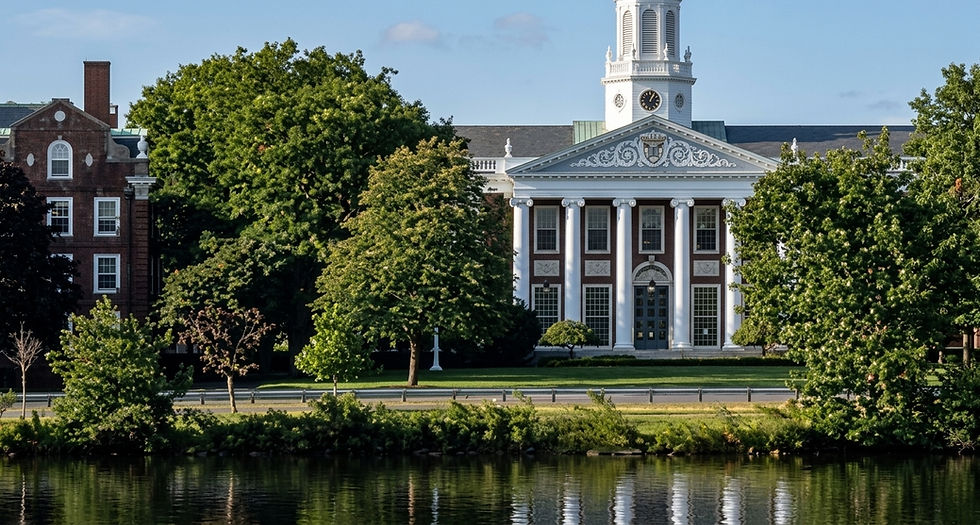
Harvard, for all its internal disagreements, has historically been one of those bridges. During World War II, Harvard Business School trained officers on campus and the Navy Supply Corps School during the war. Harvard College’s Army ROTC was established on campus in 1916, and was one of the six original Navy ROTC partner institutions in 1926. Today, over 100 Harvard students participate in ROTC, committing themselves to serving the country after graduation. These ties were and are a democratic asset precisely because they make the relationship personal. Both Harvard and the military benefited as partners at a time of national and global crisis.
That history doesn’t require blind endorsement of everything the military does. It’s simply evidence that our institutions once understood something we are currently at risk of forgetting—that you can engage in serious debate and still build durable channels between those who fight and those who govern.
Innovation is a National Imperative
Second, it harms U.S. innovation at a moment when innovation is a strategic necessity. Top universities are clusters of human capital, research, and early-stage financing. Even students who never wear a uniform can still be deeply patriotic, service-minded, and eager to work on difficult problems at the intersection of technology and national security.
At Harvard, that ecosystem is thriving. The annual Technology and National Security Conference, run by Harvard and MIT students, brings builders, operators, investors, government leaders, and academics into the same room to talk about real defense and security challenges. Programs like the Q Lab at the Harvard Kennedy School put innovators and decision makers invested in national security in the same room. Shield AI, founded by an HBS veteran, is one of the most successful and innovative defense companies of the last decade.
You don’t have to believe every defense tech startup is good to see the strategic point. Modern deterrence and battlefield effectiveness increasingly depend on software, autonomy, sensing, and rapid iteration. If the Pentagon walls itself off from major centers of research and talent on ideological grounds, it doesn’t just punish Harvard. It limits its own access to the ecosystem that can produce world-class innovation at a time when the United States can least afford self-inflicted constraints.
The reverse is also true. If elite academic institutions treat the military as a stereotype, they will produce graduates less fluent in implementation, tradeoffs, and the cost of policy. Neither side benefits, and most importantly, the country doesn’t.
Guardrails, not Barriers
A serious democracy should debate the use of force. It should ask hard questions about strategy, ethics, civilian harm, procurement waste, secrecy, and civil liberties. But severing contact is not the same thing as accountability. We can demand standards and guardrails while keeping open the channels that make democratic control real. Channels where civilians and service members learn each other’s language and perspective, and where disagreement doesn’t metastasize into mutual contempt.
The most damaging civil-military gaps don’t appear overnight; they accumulate. They manifest slowly as mistrust, policy failure, and a politics that treats both the armed forces and civilian institutions as either icons or enemies, but never as fellow citizens.
My father’s story is only one example of what can be built when those channels stay open. We should be more hopeful, and more determined, about reopening them.
The views expressed in this article are those of the author alone.

Isaac Hendrik Kim (MBA ‘26) grew up as an Army brat. He graduated from the United States Military Academy at West Point in 2016 with a degree in Foreign Area Studies. Prior to HBS, he served as an Army Aviation Officer and UH-60 Black Hawk pilot. He enjoys spending his free time with his wife Kristina and their beagle, Goofy.

Comments