
The Gospel of Wealth

The man who dies thus rich dies disgraced
Editor’s Note: Published in 1889, The Gospel of Wealth is considered the founding document of modern philanthropy. Written at the height of wealth inequality during the Gilded Age, Andrew Carnegie’s essay represents well the “do good and do well” ethos that is now commonplace in the modern business school. Below is an abridged version edited by The Harbus for brevity and clarity. We ask our readers to look past Carnegie’s dated language, to evaluate his argument on its own merits, and to come to your own conclusions. The full essay, which belongs to the public domain, can be accessed online on the Carnegie Corporation’s website.
*
The problem of our age is the proper administration of wealth, so that the ties of brotherhood may still bind together the rich and poor in harmonious relationship. The conditions of human life have not only been changed, but revolutionized, within the past few hundred years. In former days there was little difference between the home, clothing, food, and environment of the ruler and those of his subjects. The contrast between the palace of the millionaire and the cottage of the laborer with us today reveals the change which has come with modern civilization. This change, however, is not to be deplored, but welcomed as highly beneficial.
It is well, nay, essential for the progress of the race, that the houses of some should be homes for the greatest literature and the arts, and for all the refinements of civilization, rather than that none should be so. Much better this great inequality than universal poverty. Without wealth there can be no Mæcenas (patron of the arts under Augustus, the first Roman emperor). The "good old times" were not good old times. Neither master nor servant was as well off then as today. Relapsing to old conditions would be disastrous to both — not least so to the servant — and would sweep away civilization with it. But whether the change be for good or ill, it is upon us. It is beyond our power to alter, and therefore to be accepted and made the best out of. It is a waste of time to criticize the inevitable.
In the manufacture of products we have the whole story. It applies to all combinations of human industry, as stimulated and enlarged by the inventions of this scientific age. Formerly, goods were manufactured at the domestic hearth or in small shops which formed part of the household. The master and his apprentices worked and lived side by side, therefore subject to the same conditions. When these apprentices eventually became masters, there was little or no change in their way of life, and so they, in turn, educated the next apprentices in the same routine. There was, substantially, social equality, and even political equality, for those working in industry back then had little or no political voice in the government. But the inevitable result of this mode of manufacture was crude goods at high prices.
Today, the world obtains high-quality, yet commoditized goods at prices which even the generation preceding ours would have found incredible. In the commercial world, similar causes have produced similar results, and humanity thus benefits.
The poor enjoy what the rich could not before afford. What were the luxuries have become the necessaries of life. The laborer has now more comforts than the landlord had a few generations ago.
The farmer has more luxuries than the landlord had, and is more richly dressed and better housed. The landlord has rarer books and pictures, and home furnishings more artistic, than even the King could then obtain.
The price we pay for this change is, no doubt, great. We assemble thousands of laborers in the factory, in the mine, and in the counting-house, of whom the employer can know little or nothing, and to whom the employer is little better than a myth. All dialogue between them is at an end. Rigid castes form, and mutual ignorance breeds mutual distrust. Each caste has no sympathy for the other, and is ready to disparage the other at any time. Under the law of competition, the employer of thousands is forced into strict economic discipline. As the cost of labor features prominently in this discipline, there is consequently friction between the employer and the employed, between capital and labor, between rich and poor.
Yet the advantages of the law of competition are greater still, for to this law we owe our wonderful material development and the improved conditions it makes real. This law is here; we cannot evade it; no substitute has been found; and though often hard upon individuals, it is best for humanity, since it ensures the survival of the fittest. From this follows inequality of environment, the concentration of business in the hands of a few, and the inevitable accumulation of wealth by men possessing rare, special talent for organization and management — men whose ability creates capital and without whom capital takes flight and disappears. Objections to these foundations are unfounded. Civilization itself rests upon the sacredness of property — the right of the laborer to his savings, and equally, the legal right of the millionaire to his millions. Communism has been tried, and progress has come from communism’s displacement. Even if a nobler ideal imagines men laboring wholly for one another, this is not evolution, but revolution. Our duty is not to uproot existing institutions, but to bend the universal tree of humanity slightly toward better fruit.
We start, then, with a condition of affairs under which the best interests of the race are promoted, but which inevitably gives wealth to the few. The question then arises: What is the proper mode of administering wealth after the laws upon which civilization is founded have thrown it into the hands of the few? And it is of this great question that I believe I offer the true solution. It will be understood that fortunes are here spoken of, not moderate sums saved by many years of effort, the returns on which are required for the comfortable maintenance and education of families. This is not wealth, but only competence which it should be the aim of all to acquire.
There are but three ways in which surplus wealth can be disposed of. It can be left to the families of the descendants; or it can be bequeathed for public purposes; or, finally, it can be administered during their lives by its possessors. Under the first and second ways most of the wealth of the world that has reached the few has hitherto been applied. Let us in turn consider each of these modes.
The first is the most injudicious. In monarchical countries, the estates and the greatest share of wealth is left to the next generation, that the vanity of the parent may be soothed by the thought that his name and title will be passed on, unimpaired, to succeeding generations. Under republican institutions, the division of property among children is much fairer, but then a question forces itself upon thoughtful men worldwide: Why should men leave great fortunes to their children? If this is done from affection, is it not misguided affection? Observation teaches that, generally speaking, it is not good for the children that they should be so burdened by unearned wealth. Neither is it good for the state. Wise men will soon conclude that, for the best interests of their family and of the state, such giving is an improper use of wealth. The thoughtful man must shortly say, "I would as soon leave to my son a curse as the almighty dollar," and admit to himself that it is not the welfare of the children, but pride, which inspires generational wealth.
As to the second way, that of leaving wealth at death for public uses, it may be said that this is only a means for the disposal of wealth, provided a man is content to wait until he is dead before it becomes of much good in the world. There are many cases in which the goals of the giver are not attained, and there are many in which his goals are thwarted. In many cases the money given is so used as to become only monuments of his folly. It is good to remember that it requires ability equal to that which acquired the wealth, to use it so as to be actually beneficial to the community. Besides this, it may fairly be said that no man is to be praised for doing what he cannot help doing, nor is he to be thanked by the community to which he only leaves wealth at death. Men who leave vast sums in this way may be thought of as men who would not have left it at all, had they been able to take it with them. The memories of such cannot be held in grateful remembrance, for there is no grace in their gifts.
The growing disposition to tax more and more heavily large estates left at death is a cheering indication of the growing positive change in public opinion. The State of Pennsylvania now takes one-tenth of the property left by its citizens. The budget presented in the British Parliament the other day proposes to increase the death-duties; and, most significant of all, it proposes a progressive tax. Of all forms of taxation, this seems the wisest. Men who continue hoarding great sums all their lives, the proper use of which for public ends would work good to the community, should be made to feel that the community, in the form of the state, cannot thus be deprived of its proper share. By taxing estates heavily at death the state marks its condemnation of the selfish millionaire's unworthy life.
It is desirable that nations should go much further in this direction. Indeed, it is difficult to set bounds to the share of a rich man's estate which should go at his death to the public through the agency of the state, and by all means such taxes should be progressive, beginning at nothing upon moderate sums to dependents, and increasing rapidly as the amounts swell, until of the millionaire's hoard, as of Shylock's in Shakespeare, at least
"The other half comes to the privy coffer of the state."
This policy would work powerfully to incentivize the rich man to distribute his wealth while he is alive, which is the end that society should always support, as this is most fruitful for the people. Nor should it be feared that this policy would sap the root of enterprise and render men less willing to chase wealth, for to that group whose aspires to leave great fortunes and be talked about after death, it will attract even more attention. Indeed, for them it may be an even nobler ambition to have enormous sums paid over to the state from their fortunes.
There remains, then, only one way to use great fortunes; but in this we have the true antidote for the temporary unequal distribution of wealth, the reconciliation of and harmony between the rich and the poor — an ideal differing from that of the Communists in requiring only the further evolution of our current condition, not the total overthrow of our civilization. It is founded upon today’s intense individualism, and humanity is projected to put it in practice. Under its sway we shall have an ideal state, in which the surplus wealth of the few will become, in the best sense, the property of the many — because it is administered for the common good. This wealth, passing through the hands of the few, is more potent for humanity’s elevation than if the wealth had been distributed in small checks to the people themselves. Great sums gathered by some of their fellow-citizens and spent for public purposes, from which the masses reap the principal benefit, are more valuable to them than being distributed piecemeal.
In charity, the main consideration should be to help those who will help themselves; to give those who desire to use the aid by which they may rise; to assist, but rarely or never to do all on their behalf. Those worthy of assistance, except in rare cases, seldom require assistance. The really valuable men of humanity never do, except in cases of accident or sudden change. Every one has, of course, cases of individuals brought to his own knowledge where temporary assistance can do genuine good, and these he will not overlook. But the amount which can be wisely given by the individual for individuals is necessarily limited by his lack of knowledge of the circumstances connected with each. He is the only true reformer who is as careful and as anxious not to aid the unworthy as he is to aid the worthy, and, perhaps, even more so, for in almsgiving more injury is probably done by rewarding vice than by relieving virtue.
Thus is the problem of Rich and Poor to be solved. The laws of accumulation will be left free; the laws of distribution free. Individualism will continue, but the millionaire will be but a trustee for the poor; entrusted for a little while with a great part of the increased wealth of the community, but administering it for the community far better than it could or would have done for itself. The best minds will reach a stage in humanity’s development where it becomes clear that there is no way to dispose of excess wealth other than by using it — year over year — for the general good. This day already dawns. A man may die with some shares locked up in great enterprises without incurring scorn or pity, especially if his wealth is ultimately dedicated to the public interest. But the man who dies leaving vast sums of available wealth — wealth he might have administered in life — will pass away unwept, unhonored, and unsung, no matter even if it is to the public interest that his will dedicates his wealth, for he hoarded rather than acted while he was living. Of these men, the public verdict will then be:
"The man who dies thus rich dies disgraced."
Such, in my opinion, is the true Gospel concerning Wealth, obedience to which is destined some day to solve the problem of the Rich and the Poor, and to bring "Peace on earth, among men good will."

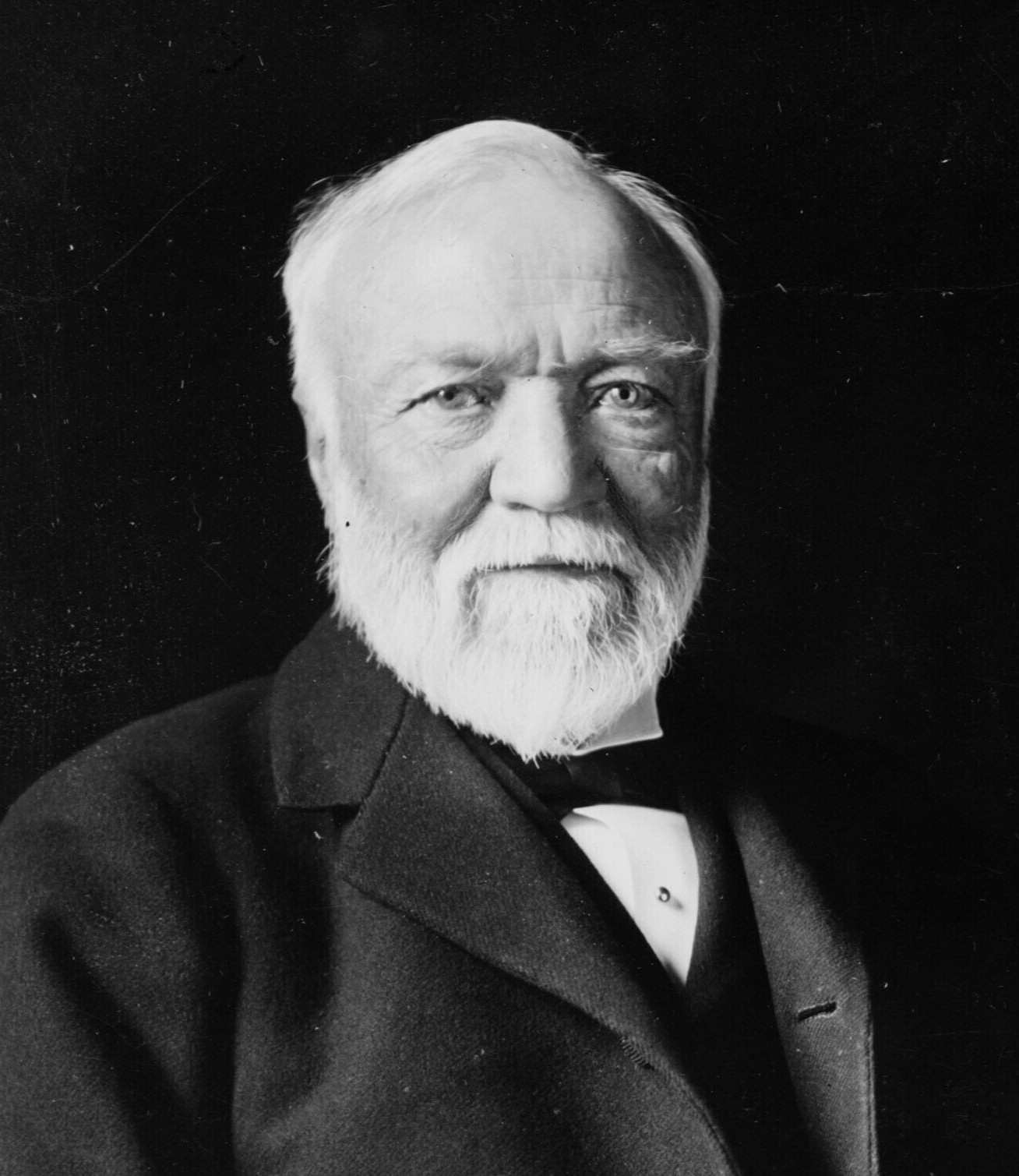
Andrew Carnegie led the development of the United States’ steel industry during the Gilded Age. He was one of its richest men and foremost philanthropists. During his life, he gave away roughly ninety percent of his fortune to charity in such areas as education and the cause of international peace.


Comments