
Unabated Cynicism: Against Chris Marquis’s Plea to Shut Down Business Schools

If you benefit from a flawed institution, stop tearing it down and start fixing it
Before he became a domestic terrorist, Ted Kaczynski was a young man fumbling about for his beliefs. Betrayed by his professor who manipulated him into a social experiment, Kaczynski slips into a deep rage, hardening into quixotic, anti-industry idealism. He writes feverishly that it would be better to return humanity to the stone age rather than live through the consequences of the industrial revolution. As I watched Unabomber on Netflix, I was struck by the persistence of this paradox: of idealism in tension with pragmatism. The creators and actors do an excellent job of reminding the audience of our youth’s wistful black and white certainty—as well as our first encounter with adulthood’s brutal grey. I can’t help but feel, too, that chronicling Kaczynski’s journey to becoming a serial killer was their effort to prompt introspection on the condition of today’s polarized society. Today, many people live in digital echo chambers. They seem unable or unwilling to bear any ideological friction (though thankfully, few are becoming serial killers). Many are either obsessed with commitment to a perfect ideal or so jaded by society’s ills that they care exclusively about personal practicality. As it was in youth, so it is now for many adults: black or white, never grey.
Put this polarity in the context of our current political dynamic, and the problem created by cynicism becomes even more salient. On the one hand, over half of Americans voted for President Trump in 2024. Many claim that he’s “just like all the others, except he doesn’t pretend.” This sentiment resonated with me when I first encountered Trump as a teen. We’re all hypocrites; some people are just open about it, I thought. Over this last decade, though, we’ve seen that ideals—however short we fall of them—act as a north star to a society and remind us of our better angels. Borrowing from Sam Harris, now that many of our leaders no longer try to appear as if they’re charting a course towards any north star, we simultaneously breathe a sigh of relief—no longer having to strive for something so difficult—and retrench to our camps, distrustful of others unlike us. As we see this effect grip others, we read their retreat as revealing who they really are rather than as the same reaction we just excused in ourselves, and cynicism takes root. Not only do we cease to give the benefit of the doubt to people who are sufficiently different, but we also succumb to a pernicious sort of nihilism. Why try at all, if what we’ve tried doesn’t work? Everyone lies, so why believe anything anyone says? It’s imperative, though, that we resist this siren song. We must prefer to have an ideal up to which we do not often live than to have no agreed-upon ideal at all. Retreating to our proverbial cabins in the woods and disengaging from society writ large is not a solution. Why? Let me illustrate through a breakdown of a particularly egregious incident of cynicism in the corner of the world in which I now live: business schools.
***
Business schools are not the highest-priority institutions to save, rebuild, or defend, but they are important ones that have an undeniable impact on society. Chris certainly cherry-picks examples in his op-ed “I Teach at a Business School. It’s Time to Shut Them Down”—Wharton is not exactly building monuments to President Trump. That said, it’s difficult to muster energy to defend the archetypes of Wall Street or the myopic profit-maximizing goals of most public companies. If his central thesis—that we should abolish business schools rather than fix them—was not so exaggerated, I wouldn’t bother. A reductive claim like this from a credentialed insider published in the pages of one of the world’s most reputable papers of record, however, forces my hand. It’s also a perfect example of the cynicism picking at the seams of our social fabric. We need nuance and depth, especially from our tenured insiders. They must not rely on a few unrepresentative examples and an appeal to authority to tear down yet another institution because of its imperfection.
It seems that one of Chris’s main justifications for abolishing business schools is that, despite trying, he can’t convince students to be “good.” They all turn to the dark side—banking, consulting, tech—and give up their moral ambition. It’s not their fault, he says, because business schools as institutions corrupt even the most idealistic among us. A flaw with cynicism is illustrated here: it often creates hypocrisy, undermining a person’s trustworthiness and elevating one’s own standing at the expense of others’. In this case, Chris is in a uniquely hypocritical position—he relies on his two decades of experience as a business school professor to make an appeal to authority that benefits few at the expense of many.
Aside from the fact that I have an unfortunately adverse reaction to any hint of hypocrisy (which, of course, does automatically make me a hypocrite; don’t worry, I’m in therapy), I believe Chris’s flawed rationale is indicative of just how flattening cynicism is. First, the definition of social impact against which he judges MBA graduates is one narrow view of what it means to have positive societal impact. Second, there is inherent contradiction in advocating to shut down business schools and re-open only for students committed to social impact. Third, for an institution’s steward to give up is an abdication of agency and accountability.
(1) What counts as “social impact”?
On the definition of social impact, I’ve begun to change my views (am I on my villain journey to banking?): while there is far too much impact-washing in sectors like healthcare and climatetech, there are still shades of impact. The tension is really twofold: (1) does a solution do enough? and (2) do the most underprivileged among society have access to this solution? Reasonable people can disagree about whether it’s worth their time to work on incremental change or material step-changes, and about the proper places for public, non-profit, and for-profit capital. But we need it all—incrementalism AND step changes, all forms of capital, and products that improve the lives of wealthy, middle-income, and poor people globally. To lament that too many students choose to make near-term income trade-offs instead of pursuing a narrow version of social impact is not just judgmental but downright cynical.
Another way to have social impact is to empower people from historically marginalized backgrounds to create wealth for themselves and future generations. Business school can be a funnel for socioeconomic mobility that levels the playing field and increases equity across a number of demographic dimensions. Many people want to go to business school to genuinely become more thoughtful leaders and to change organizations from the inside out, ensuring more equitable employment and mentorship and allocating company resources to better ends. After wealth is generated, people can generously give this wealth to the causes that fit their definitions of impact most. Business schools could do more to instill this philanthropic mindset in their captive audience and their room for improvement does not discount the version of social impact many alumni pursue in spite of it.
Finally, many students seek paths in traditional corporate roles to further hone skills they’ll need to succeed in endeavors later down the road. A scientist may choose to become a banker to understand how finance works before going on to start their own company or invest in other impactful companies. Similarly, someone may want to get a broad view across many enterprises as a consultant to sharpen up their strategic thinking before pivoting into something else.
To believe that the vast majority of business graduates care solely about their individual gains is to absorb a cynical worldview about the nature of humanity, and to abandon any amount of pragmatism for a myopic form of idealism. I would love it if everyone at HBS graduated and immediately pivoted into something explicitly socially impactful, but I also recognize that there are views beyond my own of efficient social impact. I recognize that—as a natural result of the free society that we live in and love so dearly—people will make their own choices. And it must be said that business schools did not invent capitalism; the impulse to create and capture value would not disappear if they were shut down. We see that counterfactual today. Technologists and engineers—not MBAs—lead the AI companies that so animate popular grievances against technological overreach into community and civic life.
(2) How can you convince the unconverted to care about social impact in addition to profits if they aren’t in the room?
Creating a parallel business program explicitly focused on social impact, as Chris applauds at University of Vermont, is not in and of itself a bad idea; in fact, I might have preferred that option prior to starting at HBS. However, to take what I’ve argued previously a step further, separating out “socially minded” people from the “others” nurtures group think and feeds the echo chambers. This is a path with no resistance, no challenge, and no discomfort. We’re so allergic to people who don’t have the exact same view points as us that we’d rather exclude them altogether, lest we be forced to contest our deeply-held beliefs. My classmates who were on and will continue to be on different paths from me shift my perspective and sharpen it in ways that a program with only people who confirm my beliefs would not. Believe it or not, non-profit program managers can and should learn from consultants, too.
Towards the end of his essay, Chris says: “For most of my career, I’ve taught electives focused on responsible business and sustainability—gratifying work, but largely preaching to the converted. Recently, at Cambridge, I introduced a required sustainability course filled with future bankers, consultants and tech executives who once would have steered clear.” Responsible business courses are more effective when mandated because the unconverted wouldn’t self-select into impact-oriented programs. If a social-impact-focused program was the only option because all other business schools shut down, which I take to be Chris’s ideal solution, it sounds a lot like remaking the closed institution from scratch.
Bankers, consultants, tech executives, and the like won’t stop holding power just because business schools disappear. There will just be fewer people from different backgrounds and industries with access to these places, and fewer people from traditional industries pivoting into social impact. I’m wholly unconvinced that shutting down one institution and starting another, especially through the same broader university infrastructure which Chris also believes is broken, is in any way better than trudging along the path to a broader definition of business that existing business schools are already on.
(3) Business schools have changed dramatically over the last few decades, and Chris has been a part of them for most of it.
Chris says efforts to add social impact related material “serve to legitimize the machine, not change its output.” With such a bold claim and with a background in business, one might expect some data to back this up. In its absence, let me at least share some counter-anecdotes from HBS. HBS’s Social Enterprise Initiative (SEI) is roughly 25 years old and is more than just lipstick on a pig; I can personally attest to its breadth and depth. According to the SEI, 38% of my class of 2028 cited interest in social enterprise. There are 11 social enterprise related clubs on campus, many of which have more than 100 members (though, of course, there is likely high overlap). 54% of alumni who graduated in the past 10 years are connected with the SEI. These are just data from the SEI itself, not inclusive of data from other HBS Initiatives that are focused on social impact like Business & Environment, Healthcare, and Race, Gender & Equity.
I don’t know what the Chris’s are doing at other institutions, but there are 17 HBS faculty doing just what he purports to be impossible—teaching explicitly SEI-related courses (which does not include courses that have elements of social enterprise like healthcare), researching and publishing on SEI-related topics, and shaping future curriculum. A little over 10% of HBS faculty have explicit affiliations with the SEI and related topics. In our required curriculum which students take for an entire year, cases grapple with environmental and social problems in addition to gender- and race-based issues in organizations. In the last two weeks alone, over half the required curriculum cases have explicitly focused on topics of social impact ranging from public pension management to non-profit cost variance to the ethics of and business models for reaching the poorest consumers in emerging markets. There are classes with massive waitlists in the second year that ask extraordinary questions of our responsibility—classes that require readings from Marx to Keynes to Friedman to answer them. While HBS is a sample size of one, it is a trendsetter; I feel comfortable generalizing that business schools are not devoid of institutional social consciousness.
If you think about social impact from the lens of minority access to societal positions of power, let’s think about women over the last several decades. Female students now make up ~45% of HBS. When the mother of a friend was an HBS student in the 80s, they were a vanishing minority. She was derided by her male classmates as “stealing” the spot of eligible men and suffered through myriad inappropriate remarks from professors. If business schools shape society, then women were altogether locked out of this well-traveled path to power. Imagine if we’d just shut down business schools then. Would women have magically become senior leaders in society? No. Decision-making, status-signaling, and career-designing would have moved to even smokier backrooms and more opaque networks.
Today, women have gained seats at the tables where decisions are made. Not nearly enough are in the room where it happens, but as decades of women in the workforce begin to accrue wealth, a shift against gendered career roles, once unimaginable, is now real. The majority of our leadership course cases to date have dealt with themes of gender and race in organizational structures. Continuing to read the famous Rob Parson case does not diminish this; in fact, the sharp contrast makes each discussion more powerful. Perhaps Chris observed that “deeper questions—like whether Mr. Parson is himself a product of investment-banking culture—are rarely raised” when he was at HBS over a decade ago. My class alone spent a significant amount of time talking about this exact issue. While I have an exceptional professor, I have to imagine that even the more middling ones could elicit this discussion if they so wanted.
Change often looks more like a hockey stick than a straight line—slow at first, then transformation that compounds. Are the genders at parity? Obviously not. At the same time, we do a discredit to the women (and their allies) before us to pretend like no progress has been made. It is on issues like these that we must ask: how do we train leaders in a consistent manner to value social good alongside profit? We cannot do so by cancelling the programs altogether. Consider the poor bankers who’d never even learn what a social enterprise is without their classmates.
Professors and administrators cannot give up either. To say that they tried and they just can’t do it anymore is to abdicate their responsibility. Professors are meant to be aspirational role models. Having the Chris’s in classrooms—socially conscious, concerned with how business can positively impact society—is paramount for building a universal ideal that business and society do not have to be at odds with each other. I know several professors at HBS doing just that, and I can’t fathom why Chris has chosen now to throw in the towel on the next generation of leaders. That his attempt at change at Cambridge isn’t working is in no way indicative of the potential effectiveness of change writ large. Business schools shouldn’t be the only way to produce great leaders. But institutions—including business schools—play an important role in signaling potential for success and, against all odds, actually preparing students for careers in business and management (though as with anything, garbage in, garbage out).
If the goal is to end intuitional signal-sorting because it seems inequitable, consider what happens when there are no respectable institutions to signal anything. If you’ve been living in the US for the last decade, you do not need to be all that creative in imagining that slippery slope. What if we didn’t have Centers for Disease Control to entrust our public health to, or a Department of Justice to ensure fair enforcement of the law?
We recently had a case on financing Hamilton on Broadway (yes, we learn about the arts in business school too!). George Washington’s wise words to Hamilton seem applicable here: “Dying is easy, young man. Living is harder.” It’s easy to wave our hands in the air and pronounce, when something we’ve tried doesn’t work, that we should just tear it down. Building the world we want to live in requires a patience that is not in vogue today.
Instead of tossing out inequitable institutions, make them more equitable. Propose ways to push for more socioeconomic and industry diversity. But do not, under any circumstances, give up entirely on the role institutions play in forming societies—even and especially that of the business school. Being cynical might feel good; you might convince yourself that you’re smart; you might save yourself heartache; you might even think yourself a realist, because you turn your nose up at a flawed thing. When that flawed thing plays a critical role in society, though, this attitude is nothing but proof that you prioritize self-preservation over the vulnerability required to bear the costs of your beliefs. Change requires collective action. It begins with trust, discomfort, and just a little dose of optimism.
***
Business is and will continue to be inextricably linked to societal wellbeing. We must, then, consider how to make it work towards more socially optimal ends. Business schools, complete with a thoughtful north star, are an important institution to accomplish this. The pervasive onslaught of cynicism we seem unable to shake in society right now about institutions of all sorts is creating the world cynics fear. Perception is reality.
Take this as a study in why you should short circuit your cynical impulses. Resist! Feel the discomfort coming, the annoyance, and then ask why you’re having this reaction. Ask yourself: is this a pressing problem for me? If the answer is no, dismiss it as the cost of the business of being human. If the answer is yes, ask then: “How am I uniquely suited to solve this?”
Sincerely,
Your local idealistic pragmatist


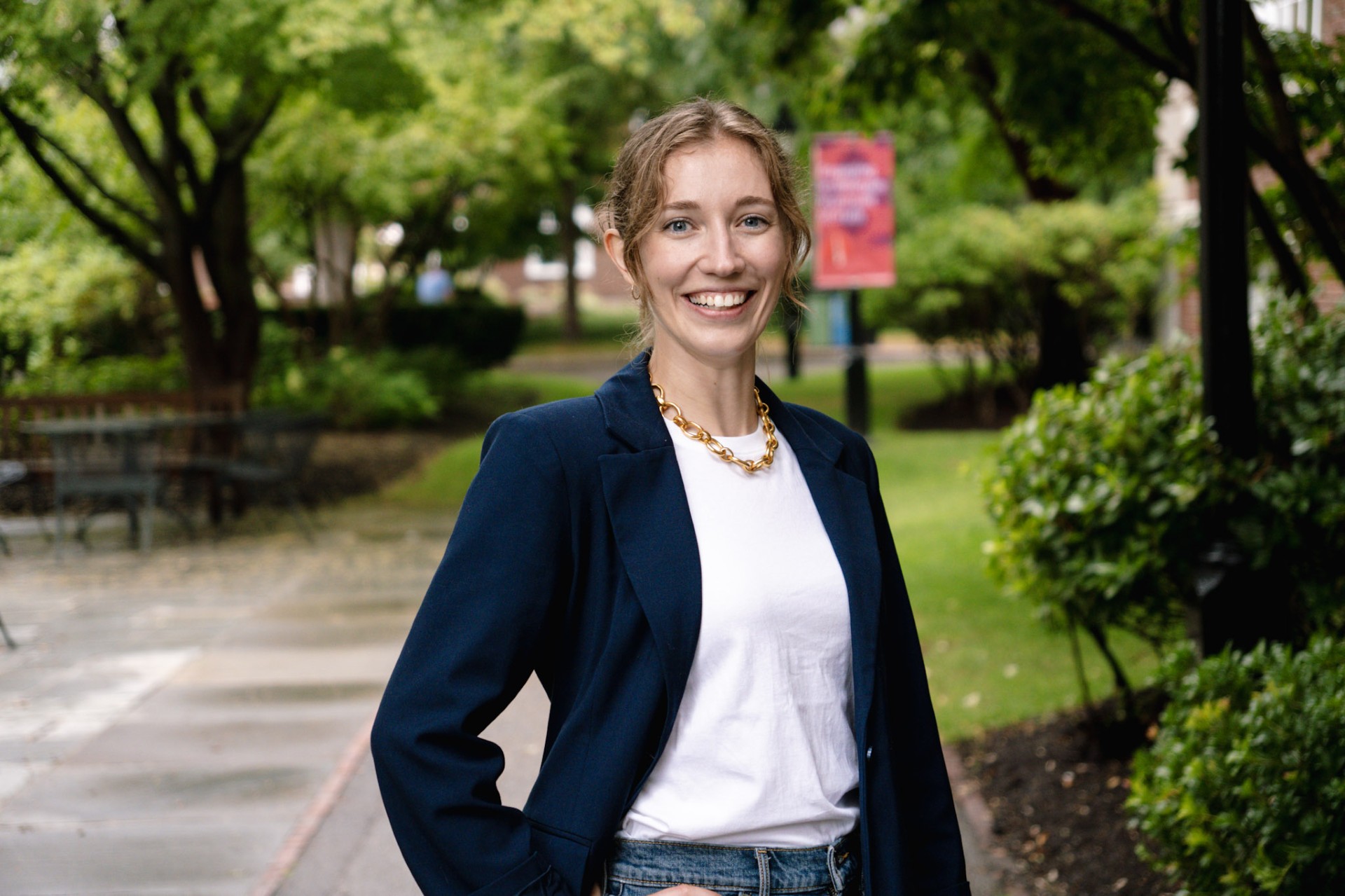
Emily Counceller (MBA '28) is from Indianapolis, IN. She studied Economics at DePauw University before beginning her career at Eli Lilly and Company in commercial forecasting. Prior to HBS, she spent 5 years on Lilly’s corporate VC team. In her spare time, you can find her climbing rocks, yapping, sampling pastries, and hanging with her husband and cat.


Comments