
How Often Should Men be Thinking About Their Sperm?


Probably more often—because men have biological clocks, too
For all the talk of reproduction, the burden of foresight still lands, reflexively, on women. At Harvard Business School, egg freezing and the specter of female fertility hover over panels, career-planning sessions, and the gaps between classes. Sperm, by contrast, floats free of scrutiny, buoyed by a persistent cultural myth: that male fertility is durable, renewable, and effectively infinite.
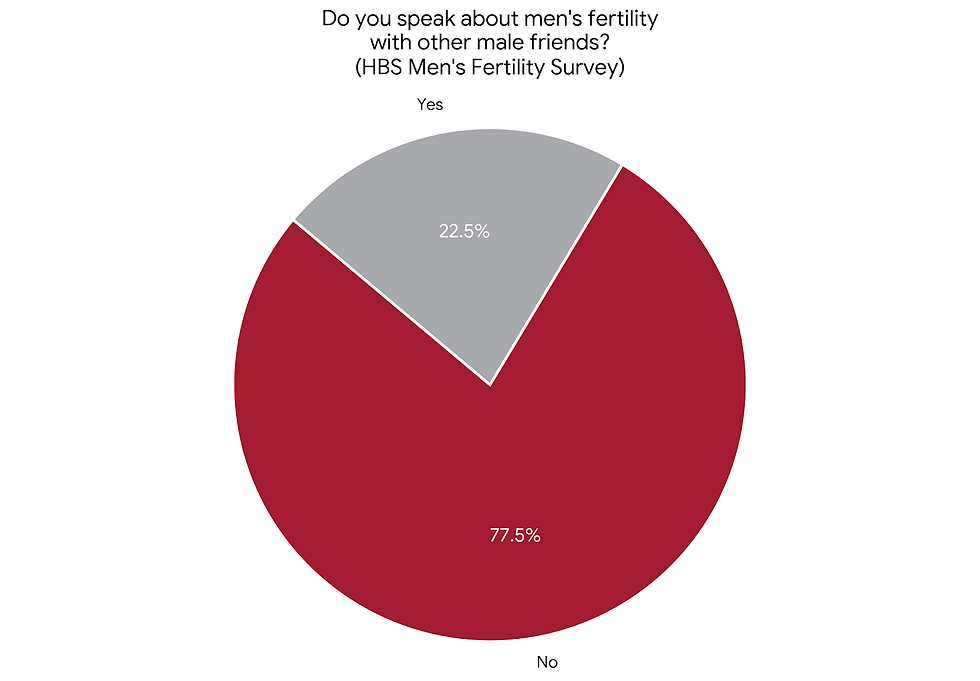
The men at HBS inhabit a different reproductive universe from the women I wrote about in my previous article. Before they arrived on campus, only eight and a half percent had ever given their sperm health any real consideration. Seventy-eight percent have never once discussed it with a friend. This data is a portrait of the quiet luxury of never having been taught to worry.

***
Although I do not want to stoke panic in the male population, men need to be thinking about their fertility and health too.
Consider the numbers. Among couples experiencing infertility—roughly one in eight, by current estimates—male factors now contribute in up to half of cases, according to a 2025 National Geographic feature. Men are solely responsible for infertility twenty percent of the time and are a contributing factor in another thirty to forty percent of cases.
The old clinical shorthand, infertility as a woman's issue, has been empirically dismantled. Sperm quality declines with age, although more slowly than women's eggs. Concentration and motility tend to decrease, while DNA fragmentation increases. According to research presented at a European fertility conference (cited in National Geographic, November 2025), men over 45 experience significantly higher miscarriage rates and lower birth rates than younger men, even when using young donor eggs to control for female age. Advanced paternal age has also been associated with higher risks of certain neurodevelopmental conditions and some congenital disorders. Sperm is not simply a delivery vehicle for half the genome; it carries epigenetic information, oxidative stress markers, and the accumulated exposures of a lifetime. To speak of male fertility as a binary, present or absent, is to misunderstand its complexity.
The case for male attention to fertility is not merely about conception rates. It is also about systemic health. Infertility in men is often an early warning signal for conditions that extend far beyond the reproductive tract. Urologists interviewed in the National Geographic piece note that difficulty conceiving can be a presenting symptom of testicular cancer, hypertension, and hormonal disorders. A semen analysis is not only a fertility test; it is, in effect, a general health screen. When a man produces a sample, he is also producing data about his endocrine function, his genetic integrity, and his long-term disease risk. This is not widely understood. It should be.
The epidemiological trends add urgency. A 2020 study in European Urology Focus (Lokeshwar et al.) analyzed data from the National Health and Nutrition Examination Surveys between 1999 and 2016, encompassing 4,045 adolescent and young adult men. The finding was stark: mean total testosterone levels declined significantly over the study period, and this decline persisted even after controlling for rising body mass index. Testosterone deficiency now has a prevalence of twenty percent among young American males. A global review in Translational Andrology and Urology (2017) places the worldwide prevalence of testosterone deficiency between ten and forty percent, with an abrupt rise in men aged forty-five to fifty and rates reaching as high as eighty percent among those with multiple comorbidities. Something is happening to male reproductive health. The precise causes remain uncertain—environmental endocrine disruptors, microplastics, sedentary behavior, chronic stress, sleep deprivation, or some combination thereof—but the signal is clear enough to warrant attention.
The irony is that male fertility is remarkably responsive to intervention. Unlike women, who are born with all their eggs, men produce new sperm continuously. The spermatogenesis cycle takes approximately seventy-two days. As one reproductive endocrinologist told The Cut, "in about half of cases, men can improve their sperm quality through lifestyle changes, often in just a few months." The same physician noted that treating male infertility is often more cost-effective and less invasive than the treatments available to women. Within three months of lifestyle changes—reduced alcohol, smoking cessation, weight management, avoidance of excessive heat—a man can generate an entirely new batch of sperm. This is a full inventory reset.
***
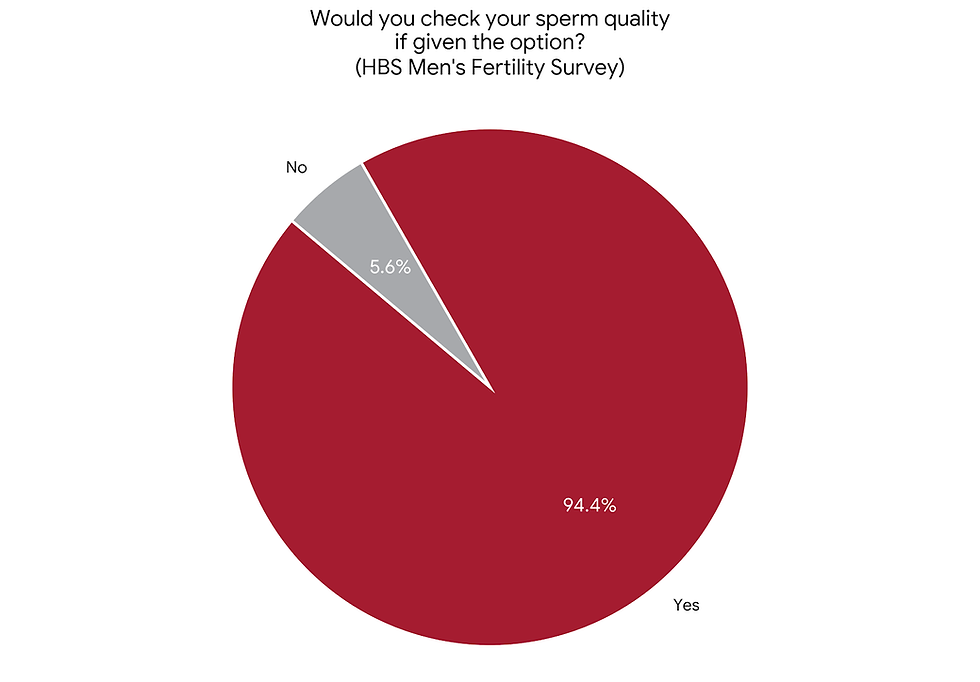
Although the men at HBS are not, by their own admission, actively talking or thinking about reproductive health, a further set of survey responses suggests something more complicated than disinterest. Ninety-four percent of the men surveyed at HBS would check their sperm quality if given the option. In addition, ninety-four percent believe they should be mindful of their lifestyle when trying to conceive. And sixty-five percent would consider freezing their sperm if necessary. To appreciate the strangeness of these figures, one must glance at the national landscape. According to data cited by Nasdaq and Progyny, sixty-four percent of American men are so afraid of what a fertility diagnosis might reveal that they simply avoid testing altogether. What we are seeing at HBS, then, is not a population inclined toward rumination or discussion. It is a population primed for action. Dormant, perhaps, but receptive. Silence is more latency than resistance.


Data shows that interest in reproductive health tends to spike once the topic is introduced. And the market has noticed. A 2026 STAT News article describes startups pitching at-home semen analysis kits as the "male version of the Pap smear," a framing designed to normalize testing while capitalizing on the same preventive logic long applied to women. The Wall Street Journal article, “ Men Are Obsessed With Their Sperm Health, and Brands Are Cashing In”, has documented the parallel explosion of male fertility supplements—products containing zinc, CoQ10, and selenium, often sold under names that land somewhere between locker-room humor and clinical aspiration. SwimClub, founded by a man who turned to Reddit and Andrew Huberman podcasts after his wife experienced multiple miscarriages, sells a $135 monthly subscription that claims to "start improving all sperm parameters in as little as two weeks" (The Cut, 2025). Bird&Be, Ritual, and Perelel now offer male prenatal packs alongside their women's lines, encouraging couples to optimize together.
Companies like Hims have capitalized on male reticence by offering discretion: subscriptions, telehealth consults, tasteful packaging. The model reduces friction, but it also risks flattening a complex issue into a consumable fix. Supplements promise optimization; tests promise clarity. The deeper question—of responsibility, of shared reproductive labor—remains largely unexamined.
The information ecosystem is equally crowded. Podcasters like Andrew Huberman and Joe Rogan have devoted extensive airtime to the theory that phthalates, pesticides, and microplastics are destroying sperm counts. Robert F. Kennedy Jr. has claimed that the average teenage boy today has fifty percent of the sperm count and fifty percent of the testosterone of a sixty-five-year-old man. These claims contain kernels of truth—the epidemiological declines documented in European Urology Focus and Translational Andrology and Urology are real—but they are often stripped of nuance and unfortunately deployed to advance broader cultural arguments about masculinity under siege. As The Cut reported in its December 2025 feature, men are increasingly convinced they are facing a fertility crisis, and they will try just about anything to revive their "fallen soldiers." The same article profiles men who inject themselves with hCG, wear underwear with built-in ice packs, and avoid dishwashing detergent for fear of endocrine disruptors. One man bought an EMF-blocking sticker for his phone, despite the Federal Trade Commission warning that such products are scams.
The risk of misinformation is significant. Not every concern is evidence-based. National Geographic confirms that underwear choice does not impact fertility, that testosterone supplementation shuts down natural sperm production, and that most supplements have marginal benefit at best. Yet the market for these products continues to grow, driven by anxiety and amplified by algorithms. A man searching for fertility advice on TikTok will encounter videos recommending that wives throw out their husbands' polyester boxers and replace them with thirty-eight-dollar cotton briefs from brands like EDN, which warns that "typical stretch clothes" contain "blood barrier crossing chemicals that impact fertility and hurt cognition" (The Cut, 2025). The science on microplastics is real and concerning, but the leap from peer-reviewed study to product purchase is often mediated by fear, not evidence.
What is striking about the HBS survey data is that it captures a population at the precise moment before that fear translates into action. The ninety-four percent who would test their sperm have not yet tested. The ninety-four percent who believe lifestyle matters have not necessarily changed their lifestyles. The sixty-five percent who would consider freezing their sperm have not made appointments. They are what marketers call a "warm audience": aware, interested, but not yet converted. The startups, podcasters, and supplement brands are all competing for the same conversion. Does that conversion serve men or merely extract from them? As men’s silence on reproductive health is broken, the question remains about what will fill it.
***
This is the question that Shailen Doshi (MBA '27) and his co-founder, Lauren Silva Laughlin, are trying to answer. Batch Global—founded by Silva Laughlin in July 2025 and later scaled with Doshi following a January 2026 Harvard seminar—does not sell thirty-eight-dollar briefs with proprietary microplastic shielding. What it sells, or intends to sell, is something rarer in the male wellness space: epistemic hygiene.
The company's website describes its mission in language almost aggressively unfussy: to help men understand their fertility and general health through data and interest, not anxiety. The library section (batch.social/library) aims to be "The Wirecutter of Sperm," offering entries on CoQ10 (the evidence is modest), microplastics (concerning, but not yet causal), and the relationship between testosterone and cardiovascular health (strong and underdiscussed). The research is updated regularly and vetted by practicing urologists and scientists. Instead of the usual "optimize or perish" messaging pervasive in the industry, Batch Global’s message is rather: here is what we know, here is what we do not know, and here is what you might reasonably do next.
Silva Laughlin's motivation for starting Batch emerged from a personal discovery: she learned that she was herself the product of sperm donation. The revelation led her into an industry she found calcified, opaque, and strangely indifferent to its own inefficiencies. The sperm donorship shortage, she came to understand, is not primarily a medical problem. It is a pricing and coordination problem. Clinics lack the technology to match donors efficiently. Donors lack the information to understand their own health and value. Recipients lack the transparency to make informed choices. Cloaked in the shame associated with male-factor infertility, it is unsurprising that the field has scarcely evolved since its inception.
Doshi, for his part, saw something he couldn't unsee: a market with massive demand, almost no supply, zero technology, and pricing that hadn't changed in decades. Batch Global is an attempt to solve all these failures at once, and its business model reflects that ambition.
Instead of pressuring men into immediately freezing their sperm when they don’t necessarily need to, Batch Global’s revenue structure relies on optionality. The donor matching platform proposes a quiet rearrangement of power—away from the banks, and towards the donors and the families who seek them. Batch Global takes a fee whenever it makes a match, acting more as a conduit than a broker.
However, by design, this business model is not a universal funnel. Many men, after all, will not become donors. For them, the company positions itself as a kind of triage layer, routing users towards fertility clinics when intervention, rather than information, is required. Even its growing library of content is treated not as a marketing appendage but as a core product. Beneath this architecture is the theory that sperm can function as the burgeoning of men taking control of their own health. Donorship, in this view, is less the business than the pretext. Doshi and Silva Laughlin’s goal is to meet men where they are to facilitate actual change.
This ethos is readily apparent in Spermaxxing, Batch's more irreverent sibling. The subdomain, spermaxxing.com, is an experiment in lowering the emotional barrier to entry. Where the main site is more educational, Spermaxxing is playful, almost goofy, using humor and gamification to make the case that learning about sperm health need not feel like a trip to the urologist. Still, the underlying message is serious: your body produces a vast amount of data about your health, and most of it is currently going to waste. Rather than being shamed into optimization, sperm, in this framing, is a biomarker, a canary in the coal mine of male health, and a surprisingly engaging entry point to understanding what your body is doing right and wrong.
Batch hopes to profit from the reduction of uncertainty. "What we see again and again," Doshi told me, “is that once men understand what the data means, they want to act. But wanting to act and knowing how to act are two different things. You need to close it with an actionable and reasonable next step." The distinction matters because the stakes are not merely commercial. The survey data from HBS suggests a population hungry for direction yet wary of exploitation. These men are not looking for a miracle. They are looking for a map.
Men who educate themselves about their fertility are not merely helping themselves. In straight relationships, the default division of reproductive labor has long been lopsided: she tracks, she worries, she undergoes the invasive tests. He provides a sample and waits. But a man who has read the research, who understands that his drinking affects his reproductive health, who knows that a semen analysis can screen for hypertension and testicular cancer is no longer a passive participant. He can say, without being asked, that he will cut back, that he will make an appointment. The load shifts, slightly, toward equilibrium. And in the context of surrogacy or donation, where the process is already mediated by clinics and contracts, a man who has done his own research, is better equipped to support the woman carrying his child. Information, in this sense, is a form of respect. And respect, in the fertility journey, is something women have been owed for a very long time.
Batch may fail. Every startup may fail. But the company's premise—that men deserve an accurate map for their health—is, at its core, a democratic one. In a broken marketplace, the most radical offering is clarity. Batch is trying to provide it without condescension, without panic, and, on the Spermaxxing subdomain, with a touch of humor. That, in fact, may be everything.
***
There is, of course, a limit to my vantage point. As a woman, I have been trained—by doctors, by media, by society—to think about my fertility as finite. I do not know what it is like to move through the world with the presumption of reproductive abundance only for this illusion to be shattered. I do not know the particular vulnerability of confronting a semen analysis in a culture that binds masculinity to potency. The silence I observed may be less apathy than unease.
Still, unease does not alter biology. If we accept that sperm quality declines, that it matters for miscarriage and long-term child health, then the asymmetry becomes harder to defend. Business school teaches its students to conduct due diligence, to interrogate assumptions of infinite growth. Male fertility, too, exists within constraints.
Men have biological clocks. They tick differently, and more quietly, but they tick. Rather than an act of self-absorption, to attend to them is a gesture toward equity. A recognition that the work of creating life begins long before conception, and that responsibility, like DNA, is shared.

Ruby Liu (MBA ‘27) has lived in every region of the US, but says that she’s from Ohio and Texas. She graduated from UT Austin with a bachelors and masters degree in Accounting. Prior to HBS, she worked in Seattle, WA with several startups, nonprofits, and at Deloitte. Her writing has been featured in several literary journals including BarBar Literary Magazine, Stoneboat Literary Journal, and Juhea Kim’s now discontinued Peaceful Dumpling. Outside of work, Ruby enjoys reviewing books on Instagram (@rubyrecreads), nature walks, and fun earrings.


Comments