
What Architecture Can Teach Us About Leadership and Innovation

The case of Smiljan Radić, Eduardo Castillo, Alejandro Aravena, and Chile
An Unexpected Journey to South America
When I was 23, I was studying architecture in Lisbon. At the time, the standard path for final-year students was to spend a year abroad. The coveted destinations were overwhelmingly European—mostly Switzerland and Italy—which made perfect sense. Those countries sat at the center of the architectural discussion in Europe and the canon we had inherited.
But I was not especially excited by any of the usual options. At the time, I had begun to feel that the European architectural conversation, for all its sophistication, was becoming a bit too inward-looking.
On the other hand, I was becoming curious about Chile.
Part of that curiosity came from a recent issue of El Croquis, one of architecture’s great publications, which had recently featured a Chilean architect with the unlikely name of Smiljan Radić. He was still a lesser-known figure by European standards. Around the same time, another Chilean architect, Alejandro Aravena, had won the Pritzker Prize, architecture’s highest honor. Back then, my classmates were not particularly interested in Chilean architecture. Most had never heard of Smiljan, and what they knew of Alejandro did not strike them as especially compelling.
I kept asking questions anyway. Eventually, I discovered that my school had created, in the previous year, an exchange with the very place where these architects had studied and now taught: the Lo Contador campus of the Pontificia Universidad Católica de Chile in Santiago. I went to the exchange program’s office and asked them to open spots again for my year. They did. Suddenly, they increased it to two slots instead of one, and just like that, my good friend Marta and I—both young, curious, and probably a little naive—were flying together across the Atlantic to South America.
Finding a new world
Once in Santiago, Marta and I enrolled in a studio course taught by Eduardo Castillo. Eduardo had worked for years with Smiljan in his small office. In the first week of the course, I also met two people who would change my life: Benja, then an architecture student and relentless organizer of art exhibitions, and Nico, whom Eduardo paired with me for the entire semester because, in his view, we “saw architecture in a similar way.” That decision alone to pair us together would have been enough for me to remain grateful to Eduardo for the rest of my life.
Eduardo taught architecture in a way I had never encountered before. For an entire semester, he made us build large models out of brick and paper, and nothing else. He positioned himself as an anti-conceptualist—not against ideas, but against the kind of architecture that begins with an abstract concept and then forces reality to obey it. Suspicious of overly polished digital form-making, he believed instead in what he called an operación: an operational model. You start with a concrete ambition and a set of real constraints, often tied to construction, and you test possibilities in physical form until a stable solution emerges. And the process is not hidden. It is visible in the object itself.
Seen from a distance, it is not so different from the logic of building a business. Some founders do not begin with a perfectly conceived solution. They begin with constraints, build quick prototypes, test, everything falls apart, adjust, and only overtime arrives at something stable and scalable. Eduardo’s lesson was that true insight does not arrive through the brilliance of an abstract idea, but through the discipline of the process.
This was radically different from the mainstream architectural conversation in Europe, where there was, at the time, a growing emphasis on spatial abstraction and the invention of new formal rules. And yet Eduardo was no anti-intellectual. He was simply obsessed, as the son of a carpenter and a master craftsman, with the idea that architecture had to earn its form through a process of contact with reality.
Connecting the puzzle
I remember my surprise when, for our final review, Eduardo invited Alejandro Aravena to be a critic to our course’s final review session. To an untrained eye, the two might have seemed worlds apart. Eduardo was rougher, more material, more suspicious of grand rhetoric. Alejandro, by then an established international figure, a former professor at Harvard GSD, was already associated with social housing, public-interest design, and an influential body of theory.
Alejandro has an extensive and evolving body of both built architecture and theory, hard to simplify in just a few sentences. But today, I would highlight one of his greatest strengths, in my view: his focus on synthesis. He understands that the more complex the problem, the greater the need for clarity, and that clarity needs to be fully informed by actual priorities. In his social housing projects, he did not romanticize poverty or hide behind architectural language. He involved communities, many of whom had never lived in a formal house before, and identified the real constraints—budget, density, family needs, expandability—and worked with the people who would actually live in those homes. The result was not an idealized complete solution, but an incremental one: “half-houses,” a framework that delivered what families needed most immediately and allowed them to add the rest over time. He often told the story that he was surprised when, asked to choose between bathtubs or hot water, the people in those communities would choose bathtubs: “They wouldn't have the money to buy the gas to make the water heater work. The bathtub, however, could be used from day one because there's a subsidy for water. This is something that from the comfortable position of a middle-class person, you may never have imagined. You take for granted that you can pay the bill for the heating.”
That, too, is a good case study for future managers. We often tell ourselves that we are customer-centric while relying on our past experiences, but Alejandro—a master design thinker—reminds us that there is a journey involved in gaining a deep understanding of a person’s exact priorities and whole life cycle: the “insight,” as it is usually called here at HBS. Architecture can make those abstractions concrete, as Alejandro’s work shows that innovation is often not about doing more, but about identifying what matters most, delivering that with precision, and leaving space for growth.
It was Benja who helped me clearly make the connection between Eduardo and Alejandro, introducing me to the work of Teodoro Fernández—an essential figure in Chilean architecture. “Teo,” a shared reference point for both Eduardo and Alejandro (and for most architects in Santiago, including Smiljan), saw architecture as the mediator and problem-solver between the environment (“territorio, topografía y geografía”) and urban geometry.
I realized that Eduardo and Alejandro, who respected each other, were both trying to solve real problems in architecture. They were experimenting in distinct registers, but both were grounded in reality rather than formality.
And sometime during that same year, I also met Smiljan.
Why talk about Smiljan, Why Now
So why begin with such a long introduction?
Because without that personal connection, it might seem arbitrary for a Portuguese student at Harvard Business School (HBS) to write about a Chilean architect. More importantly, I want to talk to you about Smiljan, and doing so without first sketching the world around him would reduce him to the kind of cultural reference one encounters on any generic architecture publication.
Why write about Smiljan now?
Because back then, Marta, Benja, Nico, and I were convinced that he would eventually win the Pritzker Prize, even when he still felt like an underground figure. This year, he did, and with that he became a mainstream figure in the current architectural discussion.
And there is much we can learn from Smiljan, just as there is from Eduardo, Alejandro and Teo.
So, in Smiljan’s case, I would emphasize three connected ideas.
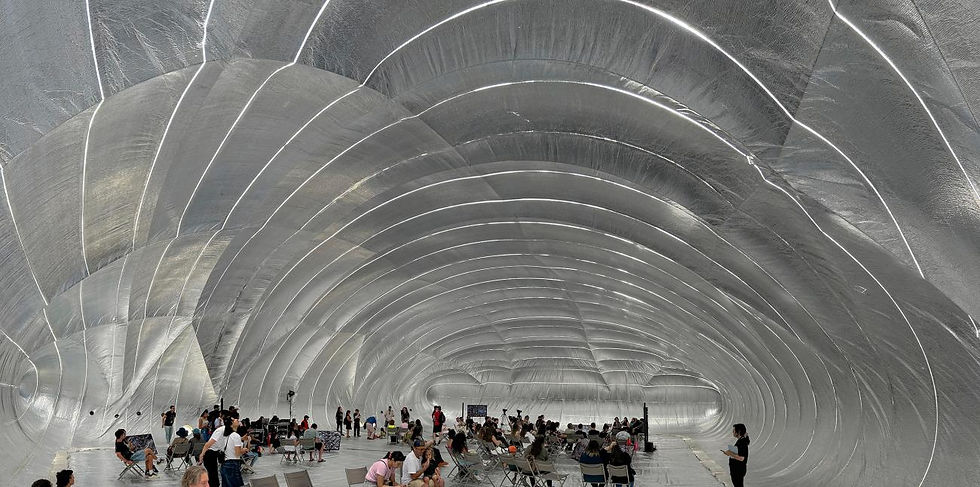
Entering Smiljan’s world: The first lesson is the importance of an Imaginarium.
To understand Smiljan, you have to understand what he calls a kind of bestiary: a world of images, creatures, materials, memories, and associations that live somewhere between the personal and the collective. His architecture draws from a deeply Chilean imaginative tradition—the poetry of Pablo Neruda, the territorial landscape of the Chiloé Islands, and the cultural roots of Mapuche communities. He brought again into the architectural discussion this idea that themes and feelings that live in our personal or communal imagination and memory can be used as fuel to resolve architectural questions and deeply resonate with anyone, creating a sense of culture or shared belief. Just as Gaudí did in the past.
That matters well beyond architecture. The most interesting business leaders are rarely the ones who respond only to what already exists; rather, they tend to sense what is already latent in collective ideas and memory and combine it with something that is still missing. Innovation, in that sense, is not creation from nothing, but the bringing together of different or unclear realities. Think of Cirque du Soleil bringing together the circus and the theater to invent a new cultural category, or Airbnb joining the intimacy of the home with the infrastructure of hospitality to make people imagine travel differently, or even the initial ChatGPT that united the simplicity of chat conversation with the information-seeking power of a search engine. The point is not the business model alone. The point is that these ventures assembled fragments of familiar worlds into a new shared possibility. That is much closer to Smiljan’s territory.
And that leads to the second lesson: what inhabits Smiljan’s Imaginarium is, above all, fragility.
His imagination is not drawn to perfect systems, heroic permanence, or seamless control. It is drawn to the improbable, the provisional, the lightweight, the exposed. Chile’s context helps explain why. It is a country in part shaped by scarcity and natural disasters. If you walk through Chile, you see fragile structures everywhere: improvised roofs, self-built shelters on the brink of collapse, temporary roadside paths, light interventions that do not dominate the land, but appear from its own materials. Smiljan does not treat these improbable and naive structures as non-architecture. He treats them as miracles, born out of uncertainty.
That is why many of his buildings seem unstable, unfinished, or strangely temporary. They do not try to erase uncertainty. They make room for it. They accept that to build seriously is not always to build with certainty. Sometimes it is to build just precisely enough, honestly enough.
For entrepreneurs or business leaders, this feels especially relevant. So much of business culture still rewards the performance of certainty: the polished narrative, the total plan and vision, the appearance of inevitability. Smiljan suggests something more truthful. Real creation often begins in conditions of fragility. You build with limited means, incomplete knowledge, and a vision that is still taking form. You work with what is available, and you remain curious.
And from that embrace of fragility comes the third lesson: how to stand in the world.
Because Smiljan is so attentive to uncertainty, he is also suspicious of moral grandstanding. He does not behave like a preacher. He does not present architecture as a sermon about virtue. He does not claim that each work carries a definitive message about how the world should be. Instead, he seems to begin from a humbler position: I am an architect, this is the discipline I belong to, and my task is to respond to each problem as sincerely as I can.
I found this liberating. Architecture, like management, entrepreneurship, and leadership, is unavoidably entangled with everything: economics, politics, ethics, technology, culture. Because of that, it becomes very easy to confuse seriousness with self-importance. One starts to believe that legitimacy must come from constant moral positioning, or from speaking as if one stood above the messiness of reality. I see Smiljan resist that temptation. He reminds us that engaging with the world does not require claiming moral superiority over it. You still have to act. You still have to choose. You still have to take responsibility. But you can do so without pretending to occupy a pure or elevated place.
That, to me, is what makes his work so valuable outside architecture. First, he shows that creation begins in an Imaginarium—an ability to assemble memory, symbols, and latent desires into something newly imaginable. Second, he shows that his own Imaginarium is grounded not in certainty, but in fragility—in structures that survive through delicacy, adaptation, and improbability. And third, he shows that living with fragility can produce not cynicism, but curiosity and humility: a way of working seriously without turning one’s work into a moral performance.
And this resonates and connects with Eduardo’s lesson about process, Alejandro’s focus on true synthesis, and Teo’s idea of architecture as mediation.
A Final Lesson from Chile
After a year, my exchange program ended. I left Chile, and after many other turns in life, today I find myself at HBS. Marta, after working in Switzerland with another Pritzker laureate who in some ways anticipated Smiljan’s sensibility, is now an amazing architect and artist in Lisbon. Benja, once an art curator in the making, is now also a fascinating and ever-surprising artist in Santiago. Nico works in Smiljan’s office and is responsible for some of the projects that are now circulated in architectural publications online and all over the world.
A few weeks ago, at around two in the morning, I had just finished reading cases for the next day and was walking toward bed when I saw the notification on my phone: Smiljan had won the 2026 Pritzker Prize. I texted the three of them immediately: “Felicitaciones, weones!” (“Congratulations!”).
“Finally,” Marta replied, perfectly capturing my own feelings.
Nico and Benja just asked how my young daughter was doing.
“She is more important than any architecture discussion,” Nico replied.
Muchas gracias, Chile.
P.S. Unfortunately, Eduardo Castillo passed away shortly after my exchange year. May this text serve as a modest reminder of how deeply we, his students, still cherish the time we spent with him.

João Sátiro Coelho (MBA ‘27) is originally from Faro and Lisbon, Portugal. He graduated from Instituto Superior Técnico with a master’s in architecture. Before HBS, João practiced architecture, then worked at McKinsey & Company in Lisbon, served as a direct advisor to the Mayor Carlos Moedas at Lisbon City Hall, where he focused on several initiatives, including coordinating the city’s partnership with Bloomberg Associates, the consulting arm of Bloomberg Philanthropies.


Comments