
Not So Partisan But Still Controversial

Where HBS stands on today’s most hotly debated policy questions.
As we began to wrap up the semester, we wanted to understand where the HBS community stands on a series of “not-so-partisan but still controversial” public-policy questions that frequently surface during discussions but rarely get measured in any systematic way. To capture that pulse, this anonymous survey was distributed to the Class of 2026 and Class of 2027 and remained open from November 18 to November 27.
A total of 226 people participated in this survey. Respondents first answered the nine ideological questions below and were then invited to share optional demographic information, including region of origin, political identity, age range, and gender.
What is your general stance on universal basic income?
Universal Basic Income (UBI) is the idea that the government would provide every adult with a regular cash payment regardless of employment status or income level. Supporters argue it could reduce poverty, simplify the safety net, and give people more flexibility in their careers. Critics worry it would be too expensive, discourage work, or crowd out more targeted social programs.
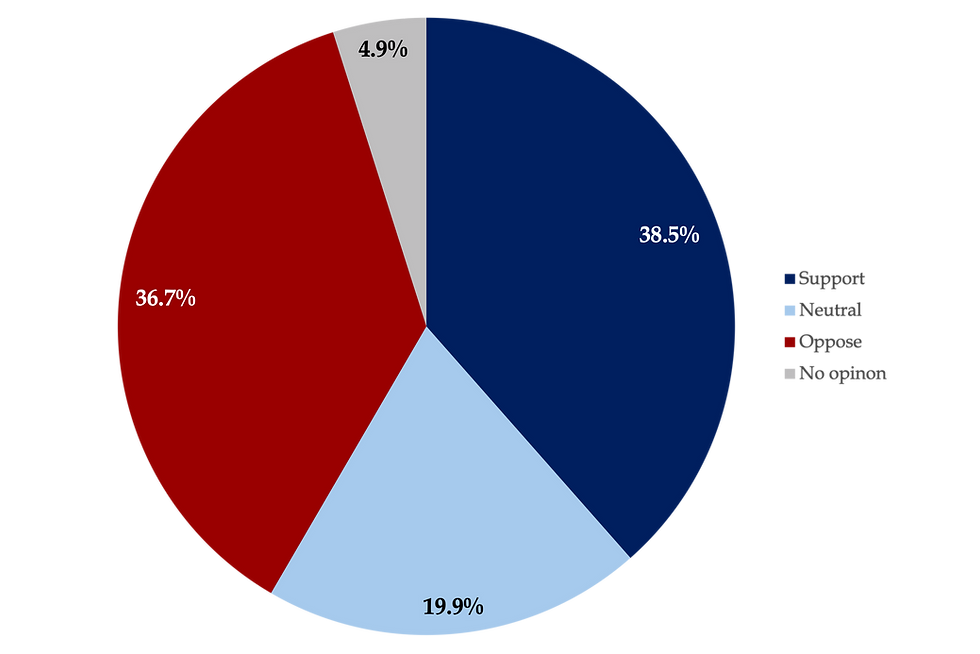
On UBI, respondents are almost evenly split. Support and opposition are neck-and-neck, with a meaningful neutral middle and a small “no opinion” group.
Politically, support comes overwhelmingly from respondents who lean progressive, with moderates making up most of the rest and relatively few conservatives. Opposition flips that picture and is anchored among conservative respondents; there is a substantial share of moderates but only a minority of progressives. Neutral respondents skew progressive or moderate. Across gender, support is more balanced, whereas opposition is notably more male.
How do you feel about the death penalty?
This asks how respondents feel about the state using the death penalty as a criminal punishment. Supporters often emphasize retribution and deterrence, while opponents raise concerns about wrongful convictions, racial bias, and whether the state should ever take a life.

On the death penalty, the majority of respondents tilt against it. Opposition is the largest group by a wide margin, followed by supporters and then a smaller neutral cluster.
Politically, opposition is driven chiefly by those who lean progressive, with moderates also more likely to oppose than support. Support, by contrast, is concentrated among conservatives and some moderate respondents, while progressives are in the minority. Neutral respondents are a mixed bag, drawing from all three ideological camps. From a gender perspective, supporters skew heavily male, whereas opposition is more evenly split.
How should the U.S. approach antitrust enforcement?
This asks whether the government should change how aggressively it enforces laws aimed at preventing monopolies and promoting competition. “More aggressive” typically means more scrutiny of large mergers and dominant firms; “less aggressive” suggests a lighter regulatory touch.

On antitrust, respondents lean toward tougher enforcement. The largest group wants the government to act more aggressively, a sizable share prefers to keep things about the same, and a smaller minority favors less aggressive enforcement.
Politically, enthusiasm for more aggressive antitrust comes mainly from progressive respondents, with moderates also contributing meaningfully and conservatives in the minority. Those preferring “about the same” are more ideologically mixed, with progressives, conservatives, and moderates all represented. The “less aggressively” camp tilts toward conservative and moderate respondents. Across gender, every answer skews male, but the “more aggressive” group includes a relatively larger share of women than the “less aggressive” group.
Should the U.S. shift toward a four-day workweek?
This asks whether the U.S. should move toward a four-day work week with similar pay, enabled by productivity gains and the rethinking of traditional work norms. Advocates argue it can improve well-being and productivity; skeptics worry about costs, client expectations, and practicality across different industries.

On the four-day work week, respondents are not as uniformly enthusiastic as popular discourse might suggest. The most common answer is “No,” with a meaningful minority in favor and a sizable neutral group sitting in the middle.
Politically, support for a four-day week is driven by progressive respondents, with moderates and conservatives trailing behind. Those who say “No” skew toward moderate or conservative, with progressives making up a smaller share of that group. Neutral respondents lean progressive but include plenty of moderates. By gender, supporters are somewhat more balanced, while opposition is more male-skewed.
How do you feel about universal childcare?
“Universal childcare” refers to government-funded or heavily subsidized childcare that is broadly available to families, often regardless of income. The idea is to reduce financial burdens on parents, support workforce participation, and provide more equal early-childhood opportunities.

Universal childcare is one of the clearest consensus issues in the poll. A large majority supports it, with only a small group opposed and a modest neutral slice in between.
Politically, support is anchored among progressive respondents, but it also attracts a sizable share of moderates and even some conservatives. Opposition, by contrast, is overwhelmingly conservative, with a smaller moderate minority and very few progressives. Neutral respondents are split roughly between progressives and moderates. Across gender, supporters are mainly men, but women constitute a substantial portion of the pro-universal childcare camp.
To what extent should gene editing be permitted?
This asks how far society should go with gene editing technologies like CRISPR. “Therapeutic uses only” typically means correcting serious diseases but not altering traits like height or intelligence. “Therapeutic + enhancement uses” would allow the use of gene editing to improve or augment human abilities, and “should not be allowed” reflects a view that the technology is too ethically or socially risky to use at all.

On gene editing, the largest group supports it for therapeutic uses only, while a smaller group is comfortable with both therapeutic and enhancement uses, and a similarly sized minority thinks gene editing should not be allowed at all.
Politically, those favoring therapeutic-only uses are mostly progressive or moderate, with conservatives making up a smaller share. The “therapeutic + enhancement” camp is more ideologically mixed, with a slight tilt toward moderates and fewer progressives and conservatives, and skews more heavily male and slightly more European than other groups. The “should not be allowed” group is disproportionately conservative, with progressives and moderates in the minority. Across gender, every stance is majority male, but the willingness to go all the way to enhancement is especially male-dominated.
What is your position on physician-assisted suicide?
This addresses whether doctors should be legally allowed to help terminally ill patients end their own lives under strict conditions. Supporters frame it as a matter of autonomy and relief from suffering; opponents emphasize the sanctity of life, slippery-slope risks, and potential pressure on vulnerable patients.

On physician-assisted suicide, most respondents support legalization, with a smaller group opposed and a moderate neutral middle.
Politically, support for legalization is strongest among those who lean progressive, with moderates also inclined to back it and conservatives making up a smaller share. Opposition comes primarily from conservative respondents, with smaller contributions from progressives and moderates. Those answering neutral are mostly progressive or moderate. In terms of gender, supporters are primarily men but include a strong cohort of women, while opposition is more heavily male.
What do you believe is the long-term future of cryptocurrency?
This asks what respondents think about the long-term future of cryptocurrencies like Bitcoin and Ethereum. Will they become mainstream financial assets widely used and held by institutions and consumers, remain niche in specific use cases, or decline significantly as a fad or failed experiment?

On crypto, the dominant view is that it will remain niche, followed by a substantial group who thinks it will become a mainstream financial asset, and a smaller bloc expecting it to decline significantly.
Politically, all three groups include a mix of progressives, moderates, and conservatives. The “remain niche” camp leans progressive, though moderates and conservatives are also represented. Those who see crypto becoming mainstream skew slightly progressive or moderate, with conservatives making up a meaningful minority. The “decline significantly” group is more evenly spread across political identities, with a slight progressive edge and notable moderate and conservative representation. Across gender, every stance is male-majority, but women are present in each camp, especially among those expecting niche persistence or mainstream adoption.
Overall, what is your outlook on AI’s net impact on societal well-being over the next 10 years?
This asks for a 10-year outlook on whether artificial intelligence will have a net positive, net negative, or neutral effect on societal well-being. Respondents are implicitly weighing productivity gains, scientific breakthroughs, and better services against risks like job displacement, misinformation, and safety concerns.

On AI, respondents are torn but cautiously optimistic. The largest group expects a net positive impact, but a nearly equally large group is negative about AI’s overall effect. A smaller portion is neutral, and only one respondent chose “no opinion.”
Politically, the negative view is most common among those who lean progressive, followed by moderates and then conservatives. The positive view is more evenly shared: progressives, conservatives, and moderates all show up in substantial numbers, with no single ideological camp “owning” optimism. Neutral respondents skew progressive but also include moderates and conservatives. In terms of gender, positive outlooks skew more male, while negative outlooks are somewhat more gender-balanced.
Note: These results reflect only the views of the 226 students who responded to the survey and should not be interpreted as representing the overall views of the HBS community.

Valerie Chen (MS/MBA Eng ‘26) is from the San Francisco Bay Area. She graduated from Yale University with a degree in Computer Science. Prior to HBS, she was a software engineer at Apple.



The unexpected mechanics in level devil 2 keep players alert, as every step may trigger a trap or unexpected obstacle.
Everything should be clear to avoid misunderstandings.
tap tap shots
The top players in the NPFL rankings for the 2025/2026 season provide a detailed look at player performances throughout the campaign. With information covering goals, penalties, matches played, and overall standings, the statistics offer more than a quick snapshot.
For football fans, these rankings can become a useful way to follow the progress of the season. They help identify standout performers, track changing momentum, and understand how individual contributions affect the bigger picture.
What initially appears to be a simple list of names and figures can turn into something much more engaging. Week by week, the rankings continue to develop, creating an ongoing narrative that changes with every match played.
Grow A Garden is an excellent browser game for anyone who wants to experience gardening, farming, and peaceful simulation gameplay online.
It’s fascinating to see how HBS students weigh in on these nuanced policy debates, balancing practical concerns with ethical considerations across topics from UBI to gene editing. Much like how an Impedance Calculator helps refine precise technical outcomes, these survey results bring clarity to otherwise abstract discussions and highlight where consensus and division truly lie within the community.