
Retail and Luxury Goods Conference: In Season, Spring 2026
Introduction
One day a year, Klarman Hall rivals the hottest clubs in Boston (read: Berryline) in its line of hundreds snaking around campus. As I told Professor Jeffrey Bussgang backstage, students and industry professionals alike come for our iconic Retail & Luxury Goods Conference goodie bags and stay for our esteemed lineup of speakers.
On March 6, 2026, we welcomed approximately 400 attendees to Harvard Business School’s campus for a full afternoon of programming:
Opening Keynote
Ewa Abrams, President of Kering Americas
Moderated by Jeffrey Bussgang, Co-Founder of Flybridge Capital Partners & Professor at HBS
Beauty Panel: “The Future Face of Beauty”
Jade Begeulin & Sabrina Sadeghian, Co-Founders of 4AM Skin
Zach Rieken, CEO of Odele
Estee Lalonde, Founder of Mirror Water
Rooshy Roy, Co-Founder & CEO of AAVRANI
Moderated by Yasmin Zeinab, Founder of ABI AMÉ
Investing Panel: “The Next Icon: Investing in Luxury & Retail”
Brian Thorne, Partner at Silas Capital
Nicole Ripka, Partner at Air @ Collab Fund
Amanda Amos, Partner at Collab Fund
Marissa Lepor, Partner at The Sage Group
Moderated by Oliver Trevena, Co-Founder of Caliwater
Luxury Panel: “Luxury, Rewritten: Heritage, Disruption, and The Next Generation Consumer”
Danielle Guizio, Founder & CEO of GUIZIO
Marielle Miller, Founder & CEO of La Complice
David Lafitte, CEO of Tecovas
Won Lee, Former US CEO of Gentle Monster
Ekta Jaisinghani, Director of Client Development at Cartier
Moderated by Amy Sturgis, Linea Co.
Startup Panel: “From Spark to Scale: Founders Navigating New Frontiers”
Kennedy Critchlow & Mary Ralph Lawson, Co-Founders of Daily Drills
Ricardo Larroude & Marina Larroude, Co-Founders of Larroude
Emily Hikade, Founder & CEO of Petite Plume
Sofia Tcherassi, RTW Director at Silvia Tcherassi
Moderated by Kiersten Barbara, Co-Founder of Rhea Creative
Shopping Journey Panel: “Where Retail Lives: Evolving Channels from Flagship to Feed”
Kate Sanner, CEO of BENI
Julia O'Mara, Co-Founder & COO of Pickle
Estelle Paladjian, Co-Founder of Cake
Jen Koen, Head of Marketing & Communications at Daydream AI
Angela Dotson, SVP of Client Development & New Markets at FASHIONPHILE
Moderated by Melissa Conner, JBC
Closing Keynote
Winnie Harlow, Supermodel and Co-Founder of Cay Skin
Kim Perrell, Co-Founder of Cay Skin
Moderated by Anita Elberse, Professor at HBS
Key Takeaways
Opening Keynote with Ewa Abrams, President of Kering Americas
Ewa opened with a window into how Kering, one of the world’s most iconic luxury houses, thinks about innovation. Kering runs an annual Innovation Day and Ewa shared that one winning pitch was a visual merchandising tool that uses AI to improve in-store efficiency and reduce errors. This served as a reminder that in luxury, the most meaningful innovation often happens long before anything hits the runway.
The conversation turned to AI and legal questions of intellectual property: Ewa noted that the biggest risk sits on the creation side, as using certain AI tools may generate output with no protectable IP attached. Her message to creatives and designers was clear: stay educated, maintain a human touch, and treat AI as an augmentation to daily workflows.
The audience was surprisingly bullish on the future of agentic commerce. When Professor Bussgang cold-called the entire audience on whether they anticipate most of their shopping needs to be handled by an agent within the next two years, over half of the crowd raised their hands. We are, of course, sampling a population that is thoroughly swept up in the AI bubble (remember when VR was going to change the world?), but this sentiment felt significant nonetheless as a real-time data point on how the next generation of consumers are thinking about agentic commerce.
Beauty Panel
A recurring theme was the belief that founders must build in public. The founders of 4AM Skin articulated something we’re seeing across the HBS founder community, as well: the emergence of a dual founder-influencer identity, where the person building the brand becomes the brand itself. It will be interesting to witness whether this behavior shifts as TikTok becomes increasingly saturated with such founder-creators.
On the retail side, DTC remains the most trackable channel. Rooshy Roy made the case plainly that DTC offers valuable insights into a brand’s end consumers. But pitching to retailers is an entirely different sport: shelf space is expensive, the competition is brutal, and for smaller, DTC-native brands, retail may simply not be the right move.
Interestingly, one founder called out the phenomenon of performative innovation within beauty, wherein brands release slight reformulations packaged as entirely new products, and expressed the hope that the industry will move towards rewarding long-term development rather than short-term trends. Such trends mentioned include K-Beauty, glass skin, and the impact of GLP-1s on skin elasticity.
Investing Panel
Though fund sizes and philosophies across our investing panel varied widely, a few threads surfaced throughout. The concept of taste, for one, arose repeatedly. Panelists acknowledged that this is in some ways a tired conversation, but important nonetheless. Nicole Ripka offered a poignant definition for taste as “consistent authenticity”; Brian Thorne called taste “the alpha.” In a world of infinite products, taste is still a scarce and investable resource.
The ideas of community and personalization emerged as other significant themes. Speakers pointed to brands like Malbon (golf as a lifestyle) and Bandit (running as an identity) as examples of what community-driven retail looks like in practice, with limited seasonal drops that sell out and intense audience engagement. Marissa Lepor suggested that assessing whether a brand has achieved systematic advantage in its operations is a better indicator of potential success than the “vibes-based” evaluation that characterizes a large portion of early stage retail investing. Given how niche consumer bases have become and how targeted marketing is today, operational edges matter more than ever.
Luxury Panel
Luxury is more than just a luxurious product. Ekta Jaisinghani shared a poignant anecdote of a customer who purchased jewelry from Cartier and, in the conversation that followed, revealed that she was buying it for her biological mother who she was meeting for the first time. This served as a reminder that luxury purchases often carry stories that are meaningful and priceless.
Won Lee brought a perspective that felt distinct, given his former role as CEO of Gentle Monster in the US. He surfaced the idea of awe as it relates to luxury: his goal at Gentle Monster was not to sell sunglasses, but to create something so unexpected that people can’t look away. Personally, as a consumer, I’ve always experienced their stores as art museums where sunglasses happen to be sold. Won’s conviction is that Asia, long one of the most powerful luxury markets in the world, is also where the most interesting experiential retail innovation is happening.
Marielle Miller, who founded La Complice directly after graduating from HBS, offered something more personal to the aspiring founders in the room: the impulse to keep collecting gold stars can lead us to a ladder that goes nowhere, and sometimes the most important part of founding is to simply begin.
Startup Panel
Both Marina Larroude and Sofia Tcherassi shared customer-first operational insights. Larroude in particular realized that customers want a comfortable shoe they can wear throughout the summer, so they ran their entire Spring 2025 collection on preorder. This was possible primarily because they are vertically integrated with their own factories in Brazil and an MOQ (minimum order quantity) of one.
Several startups noted a willingness to invest in brand-building initiatives that may look superfluous in the short-term but help cultivate a brand’s identity. Emily Hikade noted that Petite Plume chose a box rather than a poly bag for its packaging, as she believes that every surface a customer touches is part of their experience with a brand. Along a similar vein, Daily Drills regularly interacts with customers in unintuitive yet creative ways, including hosting career development workshops, visiting college campuses, and giving away travel tickets.
Shopping Journey Panel
In a way, FASHIONPHILE, BENI, and Pickle are all making the same argument: luxury is becoming less linear. Resale is growing faster than the brands themselves and ownership cycles have been replacing one-time purchases. As Angela Dotson asserted, luxury will always be coveted. The question is simply who owns it and when in a garment’s lifecycle.
Cake’s Estelle Paladjian focused on the erosion of brand loyalty, arguing that this demands an obsessive focus on making one’s top customers feel heard. Daydream AI is betting on algorithmic discovery, already finding unexpected niches like wedding occasions. The panel broadly predicted that product discovery will shift from search-based to algorithmic, which feels in-line with the opening keynote audience’s sentiment around agentic shopping.
Closing Keynote
Winnie Harlow and Kim Perrell surfaced two distinct yet equally credible founding stories. Winnie’s origin story stems from her experience living with vitiligo: after a beach photoshoot in the Bahamas left her severely burned as no sunscreen on the market worked for her skin tone without showing up on camera, she decided to build the product she’d always needed.
Kim brings a complementary kind of credibility as a serial founder and operator who has built, invested in, and exited multiple companies, including selling her last startup for $235M. When asked what she did the day after closing that exit, Kim said she told her grandmother, who had invested the first $10,000 in her first-ever business.
The crowd asked directly about the wave of celebrity-founded brands in relation to Cay Skin. Yes, Winnie is a supermodel. But Cay Skin is genuinely both of theirs, built on real product development and a mission of inclusivity. The celebrity is in service of the brand, not the other way around. The chemistry between the co-founders and their natural eloquence made for an energizing wrap to the conference. We ended the night taking photos in front of the HBS sign. As expected, Winnie knew exactly what to do in front of a camera.
Thank You
None of this would have happened without our speakers and moderators—thank you. A huge thank you to our sponsors, checkcheck and Dylign, and to the brands that made our goodie bags possible: Daydream, The Outset, Odele, Sidia, De Soi, Swoon, manucurist, JONES ROAD, David, MONDAY, by / rosie jane, BRAVO SIERRA USA, GORGIE, immi, Lo & Sons, and AG1. Thank you to the HBS Operations team, our photographer Evgenia Eliseeva, and to our RLGC Executive Team and Conference Team for making this day happen.

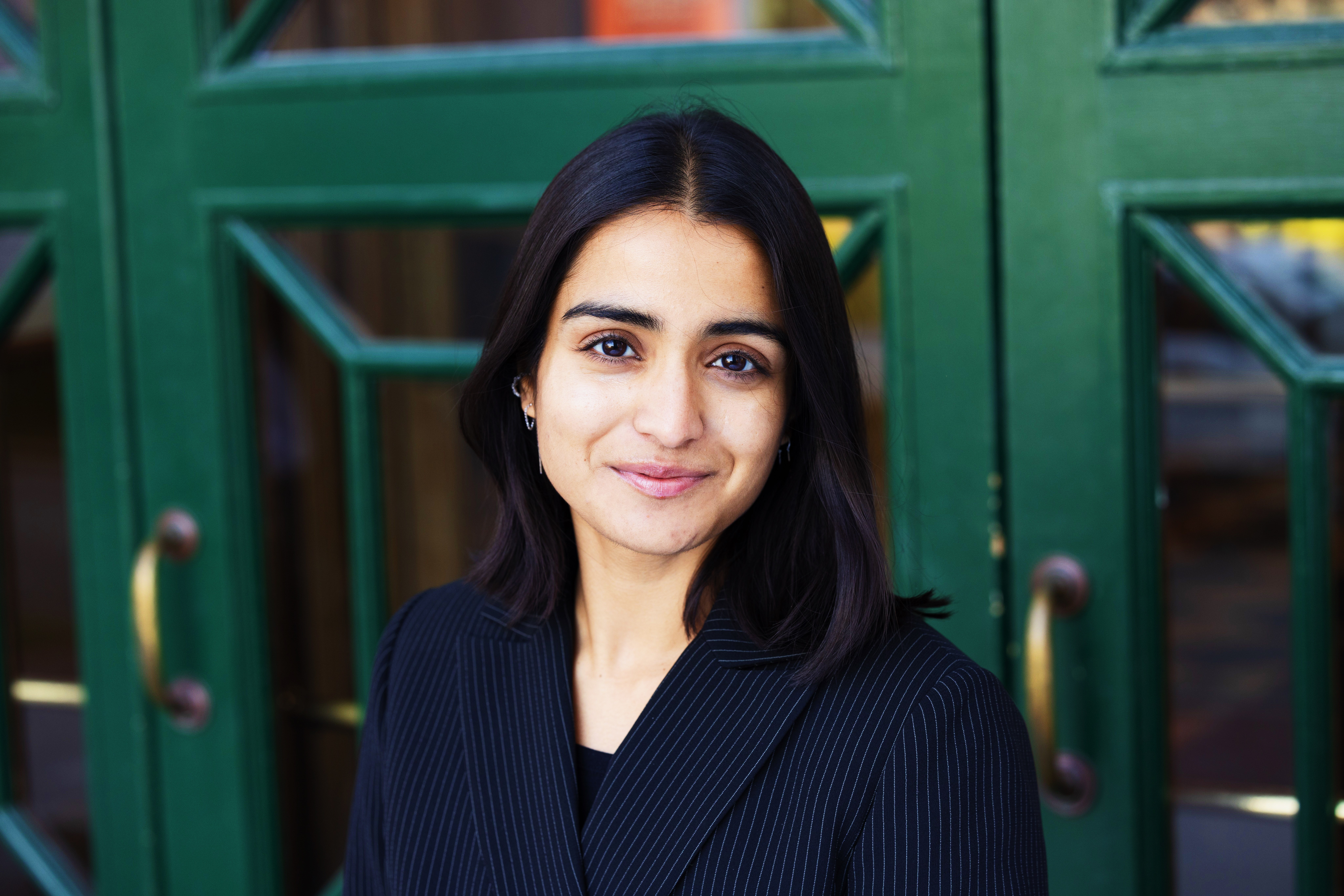
Sonal Tyagi (MBA ’26) graduated from Cornell University with a major in Electrical and Computer Engineering. Prior to HBS, she worked in fashion & luxury and digital strategy at Boston Consulting Group. While at business school, Sonal led the Retail & Luxury Goods Conference as Co-Chair and served as Chief of Staff at La Complice, an early stage fashion AI startup.



Comments