
You Can’t Handle the Veritas

And other things I believe absolutely
Note: all em dashes in this piece are mine and mine alone.
HBS’s commitment to perfection permeates the campus experience. Before winter’s first snowflake hits the ground, legions of snow ploughs are deployed across all 40 acres to tidy up the grounds. As one legendary Section Chair put it, even the squirrels are shampooed for fundraising events. They say rats that cross the Charles River turn into adorable bunnies as soon as they set foot on campus. Not a single blade of grass is allowed out of place. Oh, to pursue ETA and acquire Cambridge Landscape Co.! But I digress…
The beating pulse of the institution—the Aldrich classroom—is engineered to the lumen. Seventy-two bulbs and three kinds of lighting adorn the ceiling, illuminating every last pore. Made-to-measure Herman Millers. White oak walls and tiered rows create an academic amphitheater. Pressure-washed boards between sessions. All part of the symphony of staff whose choreography you are not supposed to notice.
HBS attends to every last detail. The question is, what for? At the back of every classroom, emblazoned on every screen, the crest of Harvard Business School displays three short syllables spread across three open books: VE-RI-TAS. Not wisdom. Not power. Truth. The motto is not decoration. It is an ontological claim about the school’s telos.
Veritas presupposes that capital-T Truth exists, that pursuing it is worth the friction, and that doing so requires the courage to say a thing is right and another thing is wrong. We have lost our taste for all three.
Every physical surface of this school is optimized around the pursuit of Truth, while the intellectual substrate has abandoned it entirely. If, as one classmate noted, “You are buying the brand,” what exactly did we purchase? A pristine amphitheater for moral cowardice?
I. The Devil’s Advocate Wears Patagonia
In June 1978, a fifty-nine-year-old Russian stood at a Harvard commencement lectern in the rain. Aleksandr Solzhenitsyn had survived the Gulag. He had been stripped of Soviet citizenship, deported, and was living in a farmhouse in Vermont. The West had, in a sense, claimed him. He was the dissident who had exposed the Soviet system from the inside, and he had come, presumably, to thank his hosts.
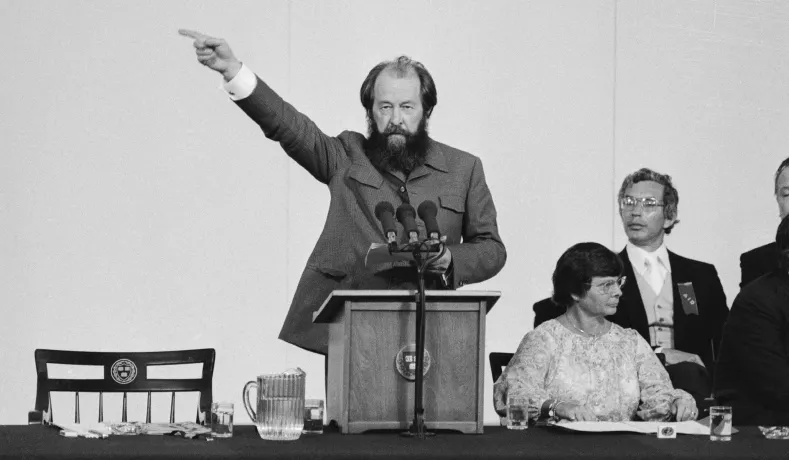
The audience expected a tribute. A celebration of the free world that had taken him in. What they got instead was a diagnosis. "A decline in courage," he said, "may be the most striking feature which an outside observer notices in the West in our days." He named the symptoms: the timidity, the pursuit of comfort, the preference for legal reasoning over moral reasoning, the intellectuals who had lost their nerve. His secretary had translated the speech the night before and wept. "He will not be forgiven for this," she told his wife.
She was right. The audience booed. The New York Times called him arrogant. Harvard moved on.
The speech was called A World Split Apart. Its central claim was that the civilization Solzhenitsyn had risked his life to reach was losing the moral nerve that had made it worth reaching. Pursuing Truth, he argued, is not primarily an act of intellect; it is an act of courage. It is the willingness to say that a thing is right and another is wrong, and to pay the price when it is unwelcome.
That was forty-seven years ago. Here is how that warning aged.
For three years running, Harvard scored last or near-last in the Foundation for Individual Rights and Expression’s (FIRE) national free-speech rankings. The university responded with the president’s Building Bridges Fund—an initiative supporting projects that “aim to break down campus divisions.” HBS’s version, christened “Across the Aisle,” attempts to bring classmates together “openly, rather than through debate or persuasion.”
The nomenclature is a Freudian slip, an admission that our dialogue has devolved into political tribalism. But the fatal flaw is methodological: they explicitly named the two prerequisites for pursuing Truth and promised to avoid them.
Why avoid debate? Because persuasion risks friction, and friction is socially expensive. The evidence is the daily dance in Aldrich. A student with a contrarian insight will inevitably neuter their own point before making it: "I don't necessarily believe this, but just to play devil's advocate..." We are terrified of being caught holding an unpopular bag.

This student timidity is met with an equally conflict-averse faculty. When a professor asks a binary question about unit economics and receives a soliloquy about an unrelated brand initiative, a callback to a point made twenty minutes prior, or a deeply personal but entirely irrelevant anecdote, they are often simply too nice to say, 'That is incorrect.' They politely ignore the absurdity, admirably bending over backwards to reformulate the question so the non-sequitur feels validated.
Courage is the virtue that makes all others possible. Without it, Truth escapes us.
II. The Cirque du Moral Relativism
When the foundational claim of an institution is hollowed out, the institution does not collapse. It continues to operate, perfectly lit and immaculately landscaped. But when it loses its moral nerve, it requires an intellectual alibi to justify its retreat from objective reality. On this campus, the abandonment of truth-seeking has spawned a parasite. It is the blight of moral relativism.
This retreat is not a localized phenomenon. Last month, Yale released a 50-page Report on Trust in Higher Education. After a year of deliberation, they concluded that plummeting public trust could be solved with device-free classroom policies and new grading percentiles. They completely ignored the actual bullet wound: a decades-long academic project, broadly termed "deconstruction," aimed at dismantling the central commitments of Western civilization—chiefly, the pursuit of objective Truth.
But here we encounter a massive, expensive contradiction. If the system is just a narrative of power, and Truth is just a cultural construct, why are we paying a quarter-million dollars for the privilege of sitting in these seats?
Because we know the brand matters. We derive immense value from the halo effect of Harvard. But we conveniently ignore that this brand was built over centuries by a rigorous, unapologetic commitment to the exact thing we are now taught to deconstruct. We are liquidating the reputational capital of Veritas to fund our own optionality, destroying the foundation while admiring the house.
To survive that cognitive dissonance, we need the alibi. Formally, moral relativism is the philosophical premise that objective Truth does not exist—that right and wrong are merely byproducts of cultural consensus, historical context, or personal preference. In HBS terms, it is the unspoken classroom rule that no answer is inherently more true than any other, no judgment more grounded than the next, and the only sin worth naming is the sin of being too sure. It is the mechanism that automatically demotes any definitive moral claim into "just one perspective among many."
It arrives dressed as kindness, as humility, as the gentle posture of the enlightened student who would never presume to judge. Live your truth. Who am I to say? The two most repeated words in Allston: It depends.
Beneath the costume, relativism is not the humble, tolerant worldview it pretends to be. In The Closing of the American Mind, Allan Bloom warned of the closed-mindedness that elite institutions foster. By championing a very specific kind of “openness”—a moral relativism where all values are equally valid—this forced receptivity paradoxically produces a completely closed mind. If all truths are relative, there is no imperative to seek the objective one. The pursuit of Veritas is officially canceled.
If we take the philosophy seriously for a moment, the entire concept of an HBS case discussion is a farce. If there is no shared objective reality, we aren’t actually debating; we are just ninety people in a horseshoe concurrently talking to ourselves. When a classmate raises their hand and says, "I #respectfullydisagree," what they are structurally forced to mean under relativism is, "My chemically induced brain-state prefers a different flavor of mouth-noise than yours."
Our analytical frameworks are remarkably elastic. The moment a claim gets uncomfortably close to something definitive, the room defaults to something tantamount to:

The logic contorts itself to protect the room's political consensus. The framework of objective Truth is tolerated only when it is convenient.
What does this alibi look like in practice? Picture a Tuesday morning in Aldrich discussing the Wells Fargo case.
The executives have just overseen the systemic creation of millions of fraudulent bank accounts. The professor pauses, chalk poised, and asks the section for the primary takeaway. In a sane world, the answer is: "This is coordinated, objective theft." At HBS, a hand shoots up from the skydeck: "It’s a fascinating study in aggressive sales culture, but they really mismanaged the compensation levers." We nod gravely. The professor writes Misaligned Incentives on the board. We have just successfully sanitized objective larceny into an organizational behavior diagram.
The relativist position refutes itself the moment it opens its mouth. To state that "there is no absolute truth" is, itself, an absolute truth-claim. The relativist cuts down the branch they are sitting on and is still surprised when they hit the ground. They are operating inside a worldview that cannot be coherently stated; it can only be assumed.
Worse, this forced tolerance breeds a profound intolerance of anyone who softly suggests otherwise. Karl Popper diagnosed this as the "Paradox of Tolerance": if an institution is tolerant without limit, its ability to be tolerant will eventually be seized or destroyed by the intolerant.
In the HBS classroom, the dogma has become: no dogma. The orthodoxy becomes: no orthodoxy. And the person who softly suggests otherwise is told, politely, that they are the problem.
And when the costume slips—when a student actually grounds an argument in objective right and wrong—relativism reaches for its favorite weapon:
“Why do you care so much?”
It is the classic dismissal. Its function is to move the conversation from what is true to why you are the kind of person who brings it up. Once that move has been made, the original argument is dead. The person who can make you answer for caring has already won, without ever having to state whether they actually think you are right or wrong.
That is the philosophy. The reason most people hold it has nothing to do with philosophical rigor. They hold it because of what it allows them to get away with. It is adopted because of the specific, comforting promises it makes about how they can live their lives.
III. The Hidden Cost of a Hedged Life
I, for one, am no arbiter of Truth. This piece is merely my humble appeal (#MyTruth) to HBS to remember that Truth exists. And an attempt to show that moral relativism is not the humble, tolerant worldview it pretends to be. Veritas is, after all, the very foundation upon which this institution was built.
Relativism promises you that your life is your own. It delivers a life with no story.
Under any coherent account of a human life, you are the protagonist of a narrative. It is the architecture every great story follows—what Reza Joseph Campbell dubbed the Hero's Journey. If you don’t know what I’m talking about, don’t worry, it’s coming.

They are right, though: actions move you toward heroism or away from it. But what is rarely said out loud in these hallowed halls is that the Hero's Journey cannot survive inside a relativist universe. It requires a destination, a transformation, and a standard of heroism that exists outside the hero. It requires an antagonist whose project is actually wrong—not differently valid, actually wrong. Strip the standard away, and the journey collapses into a wander. The dragon is just a misunderstood stakeholder. Heroism becomes a genre preference. You have traded a story for a mood.
If you push a relativist on this, they will retreat to the final defense: "If it makes me happy and harms no one, what business is it of yours?"
Notice what this presupposes: that the self making the choice is an island, that harm is a thing visible only in the moment of action, and that the costs of a private decision stay private. But the market responds with perfect, ruthless logic to what the philosophy rewards. If the point of life is frictionless self-realization, and there is no objective moral standard to govern capital allocation, the results are entirely predictable.
This is why our campus culture eagerly welcomes executives to discuss the “growth metrics” of the business of infidelity. It is why, while already staving off any sort of long-term commitment, we seek advice on how to turn the vow of marriage into a hedged derivatives contract. Are we capable of committing to anything at all? We don't have to normalize everything, you know.
When you abandon the pursuit of Veritas, the only standard left is margin. We are not pushing boundaries; we are simply watching the logical conclusion of a framework that has no vocabulary left for the word "sacred."
Yet, the facade is fragile. Consider how this exact same classroom responds when someone mentions Jeffrey Epstein.
It is one of those rare moments where the room achieves total unanimity. Professor, students, scribe. Nobody hedges. Nobody says, “Well, from his point of view…” . Nobody asks the skydeck to steelman the take. Eighty-seven type-A personalities (Section X had departed for the weekend)—normally so careful to attribute every claim to an elastic framework—agree instantly and totally. It is a recognition of the kind of wrong that does not depend on the tribe of the perpetrator, the zip code of the victim, or the political quarter currently claiming offense.
It passes in four seconds. We move on. But for those four seconds, the room stops performing relativism and tells the truth about itself. There is a moral substrate every single one of us shares. We believe some things are actually wrong—not wrong-for-me, but wrong.
If moral relativism were an accurate description of reality, then we are all just self-contained units of preference. The rational move would be atomization: minimize obligations, maximize optionality, and exit anything that constrains you.
But this is not what we do. It is certainly not what HBS students do. The Section experience, for all its choreographed camaraderie, reveals something the philosophy refuses to admit: we are thirsty for connection, for continuity, for the kind of relational commitment the relativist worldview says we should be fleeing. We plan the weddings. We send the group-chat memes. We will (I hope) show up to the funerals. We fly across the country to have dinner with someone we met eighteen months ago at ASW.
If the philosophy were right, all of this would be a mistake—a sentimental detour from the rational pursuit of self-realization. The reason we keep showing up for each other is that, beneath the costume and the frameworks, we know the alibi is a lie. We know the Truth exists, and we know we are starving for it.
IV. Your Honor, I’ve Been Framed
Most HBS students take Negotiation. The prime directive of the discipline, buried beneath the vocabulary of ZOPAs and BATNAs, is this: whoever sets the frame wins. By the time the negotiation begins, the person who defined the terms of the conversation has already, invisibly, done most of the work.
Writing and teaching business cases is a brutally difficult job. But the case method goes undefeated in Aldrich because it decides in advance what is and what is not on the table. Pedagogically, this makes sense; guardrails preserve the eighty-minute exercise. But what if the frame is incomplete, inaccurate, or simply biased?
Take colonialism. Every case touching it opens with the same pre-loaded framing: colonialism is an unambiguous evil, The End, now let us analyze how firms should respond to its lingering effects. As a Mexican, I am well aware it is a loaded topic; our politicians still routinely demand formal apologies from Spain as a form of political theater. But beyond the posturing, it is a rich, complex history that holds intrinsic value. Yet the case provides an entire ZOPA set without negotiation. Defensible historical literature on the complexities of the era is framed out.

A few weeks later, China's Belt and Road Initiative comes up. Coercive infrastructure financing is suddenly framed as "strategic patience." The same action, seven decades apart, is assigned opposite moral weights by the framing of the case.
Thus spoke ZOPAthustra.
This is not really about the case method. Aldrich is just a container. The case method rehearses, in miniature, what the modern world will do to you in full.
Every idea you encounter—in an algorithmically curated feed, or a corporate meeting where the consultant has already decided what the question is—has been framed before it reaches you. Somebody chose what was on the table. Somebody chose the name of the problem, and by naming it, determined what you would accept as the solution. Like David Foster Wallace’s proverbial fish asking "What the hell is water?", we are swimming in downstream consequences of frames other people built.
The measurable symptom of this intellectual surrender lives across the river. Harvard's Dean of Undergraduate Education recently called the College's grading system "failing," with 85% of grades now in the A-range. HBS is not the College, but the underlying disease is identical. The case method only works if students believe there is an objectively better answer. Grade inflation is what happens when a faculty, exhausted by the friction of defending objective standards, wearily concedes that there isn't.
V. The Score Beneath the Noise
If relativism is wrong, what is Truth? Let me start with what it is not. Truth is not a single framework crushing all the others. Truth is not the claim that your angle on a problem is worthless because mine is complete. Truth is not what the relativist fears it is.
The classical view—the view this school was built on—has always made room for multiple legitimate formulations. Imagine I describe two creatures to you. The first is small enough to fit in a handbag, weighs a pound and a half soaking wet, has the bone structure of a sparrow, and yips at sounds only dogs and dolphins can hear. The second weighs a hundred and fifty pounds, stands waist-high to a full-grown man, was bred to take down boars, and yanks her owner, Luis Penichet (MBA ‘26), across campus. Two animals. Different sizes, different shapes, different temperaments, different jobs. By any naïve count of features, they share almost nothing. And yet you knew, before I told you, that both are dogs.

The Class of 2026’s Mr. Personality & Justice
Where does this concept dog live? Not in the Chihuahua. The Chihuahua is just a Chihuahua. Not in the Great Dane. The Great Dane is just a Great Dane. And yet the category is real. You can pick a dog out of a lineup of cats and wolves and badgers without consulting a dictionary. The form is doing work the parts cannot account for. It is doing work the parts require.
This is what Truth looks like when you take it seriously. The relativist points at the Chihuahua and the Great Dane and concludes: look, no shared essence, the category is a fiction we project for our own convenience. The classical view replies: yes, the variation is real, and yes, both creatures are fully themselves — and your ability to know they belong on the same side of a line that separates them from cats and wolves is the proof that the line exists.
Truth, on this view, is symphonic.
Many parts, one composition. That a thing can be approached from many angles does not mean there is no thing to be approached. It means the thing is rich enough to deserve many approaches.
This is what LEAD is supposed to be teaching us in its better moments. Not that every leadership style is equally good in a vacuum. It teaches that different styles can each be fully themselves and point, together, at something the organization objectively needs. The finance professor, the marketing professor, and the ops professor disagree because the firm is complex enough to require all of them. They are not proving there is no firm. They are proving there is.
We have confused pluralism with cacophony. Pluralism is many disciplines playing one score. Cacophony is the orchestra pretending there is no score while the conductor quietly rewrites the sheet music based on the political consensus of the audience. One is truth-seeking. The other is the frictionless theater this essay has been ranting on for eons.
When you abandon the score, the only metric left is power. This is why most of what passes for controversy on this campus is not, in the end, about Truth; it is about political valence. The question of whether Truth exists is upstream of every political debate, and its disappearance has made those debates poisonous. The fight in Aldrich is rarely over whose argument is more accurate; it is a battle over whose tribe gets to impose its preference.
As G.K. Chesterton observed: the object of opening the mind, as of opening the mouth, is to close it again on something solid. A mind that never closes on anything is not open. It is empty.
VI. Heavy Lifting
In 1987, John Shad gave HBS $30 million to fund an ethics curriculum. He was tired of watching Baker Scholars turn into felons. Dean John McArthur accepted the gift with a caveat: the school was not designed "to take 26- or 27-year-old moral cripples and deal with that."
McArthur misdiagnosed the future. We are not moral cripples by nature. We have been made into moral cowards by training.
Today, when an HBS student says "Shad," they do not mean the ethics curriculum. They mean the gym. We walk in every morning to track macros and break PRs, hyper-optimizing our physical metrics while the exact muscle Shad paid $30 million to cultivate atrophies.
That muscle is courage. Nearly half a century ago, Solzhenitsyn told us this was coming. But Cassandras always get written off. We forgot that honesty without courage is only honesty until it costs you something.
In a few months, we will walk across a stage to “become leaders who make a difference in the world.” If we carry the relativist alibi with us, we will be perfectly equipped to sanitize the next disaster, but entirely incapable of preventing it.
Veritas is not a decorative crest. Recovering our belief in objective Truth—and enduring the friction of defending it—is the single most contrarian bet a graduate can make. It is built steadily, in the thousand small choices where speaking the truth has a cost.
The building carries Shad's name. The shield carries Harvard's promise. But the muscle carries nothing, until you choose to bear the weight.

Santiago Gil Gallardo (MBA ‘26) is originally from Mexico City. He graduated from Tecnológico de Monterrey with a degree in Industrial and Systems Engineering. Before HBS, he worked in venture capital at IGNIA and investment banking at a boutique firm in Mexico City.


Comments